Explore our network of country and industry based websites to access localized information, product offerings, and business services across our group.
Log in to start sending quotation requests for any product.
Don't have an account? Sign Up Here
Home Bakery Meal Sourcing Guide for Feed Industry Buyers and Suppliers
Trade Insights | Applications and Buyers | 10 June 2026

Introduction to Bakery Meal in Industrial Feed Markets
Production Process and Raw Material Sourcing of Bakery Meal
Key Applications of Bakery Meal in Livestock Nutrition
Quality Parameters and Procurement Standards for Buyers
Global Supply Chain and Market Availability of Bakery Meal
Buyer Intent and Procurement Decision Factors
Conclusion: Strategic Sourcing Opportunities in Bakery Meal Markets
Sources
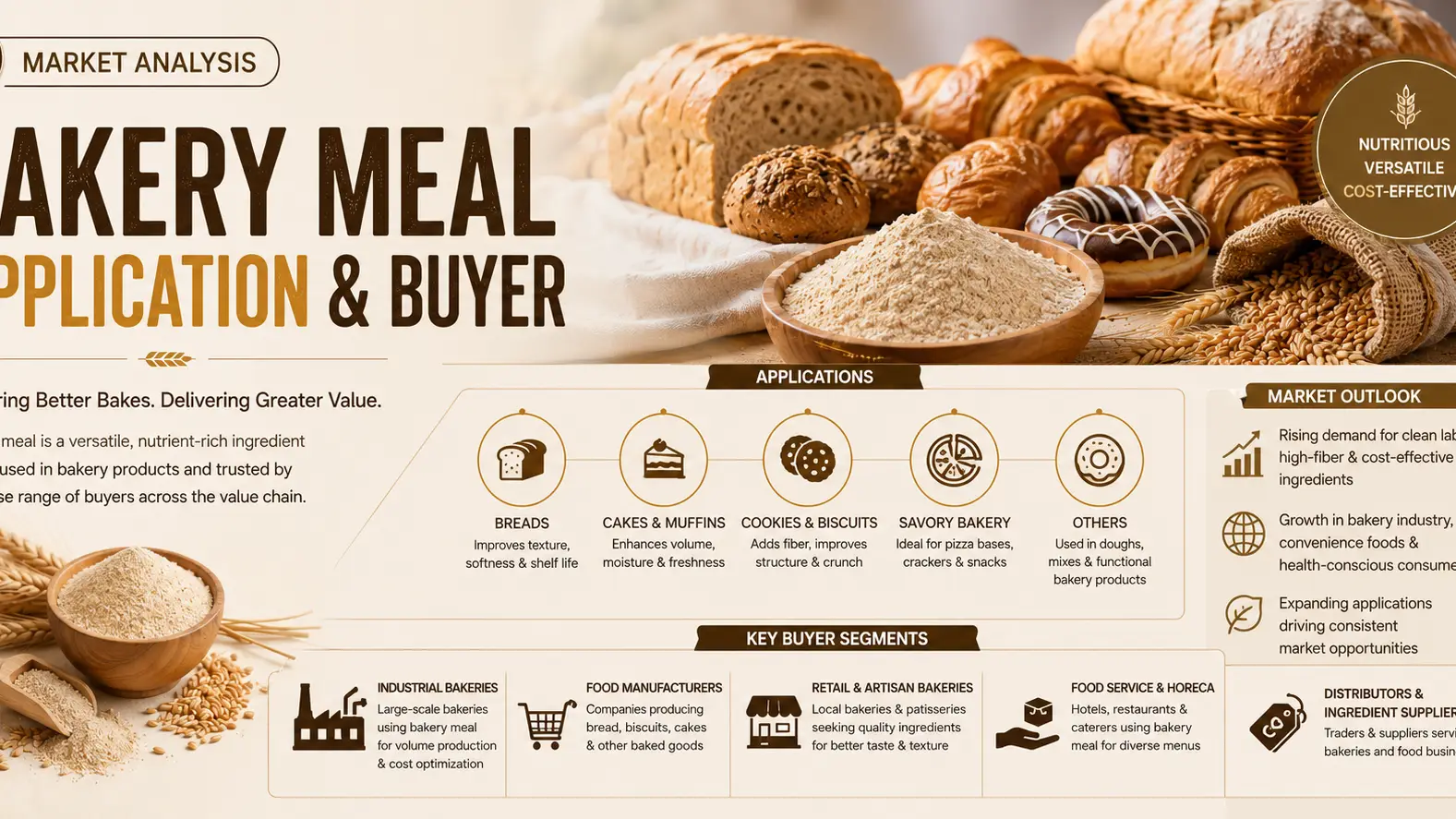
Bakery meal is a processed feed ingredient derived from surplus or unsold bakery products such as bread, biscuits, and confectionery items. It is commonly used in animal nutrition as an energy-rich feed component due to its high carbohydrate content. According to the Food and Agriculture Organization (FAO), global food loss and waste contributes significantly to alternative feed development initiatives in agriculture.
From a commercial perspective, bakery meal is positioned within the circular economy model, where food waste is repurposed into valuable industrial inputs. This makes it particularly relevant for feed manufacturers and agricultural processors seeking cost-effective energy sources. The material is typically dried, ground, and standardized before being supplied to feed mills.
In B2B markets such as those served by Tradeasia and Chemtradeasia, bakery meal is traded as a bulk commodity for livestock feed production. Its value lies in its consistency, availability, and competitive pricing compared to traditional grains.
The increasing pressure on feed raw material prices has elevated interest in alternative feed ingredients like bakery meal. Industry research from OECD-FAO Agricultural Outlook highlights rising demand for sustainable feed sources due to global grain price volatility.
Bakery meal plays a key role in reducing dependency on conventional cereals such as corn and wheat. This is particularly important for regions facing import dependency or supply chain disruptions. As a result, it has become an attractive option for feed mill operators.
The product also aligns with sustainability mandates in agriculture, where waste valorization is becoming a procurement priority. Feed companies increasingly integrate such ingredients into their formulations to improve environmental performance metrics.
Bakery meal production begins with the collection of surplus bakery goods from manufacturers, retailers, and food service providers. These materials are carefully sorted to ensure they meet basic safety and quality requirements before processing. According to the European Feed Manufacturers’ Federation (FEFAC), food by-products used in feed must comply with strict hygiene regulations.
The collected bakery waste is then dried to reduce moisture content and prevent microbial growth. After drying, it is ground into a uniform particle size suitable for blending into animal feed formulations.
This standardized process ensures that bakery meal remains stable during storage and transport, making it suitable for international trade in bulk quantities.
Once processed, bakery meal is integrated into feed ingredient supply chains where it is distributed to feed mills and distributors. The supply chain is highly dependent on food manufacturing clusters and urban food surplus availability.
Market analysis from USDA feed ingredient reports indicates that alternative feed materials are increasingly incorporated into industrial feed blending systems. Bakery meal fits into this structure due to its predictable energy content.
This makes it a strategically important commodity for procurement teams looking for reliable, scalable feed inputs.
Bakery meal is widely used in poultry and swine feed formulations as a high-energy carbohydrate source. It helps improve feed palatability and provides a cost-efficient alternative to maize-based energy inputs. Research published in animal nutrition journals indicates that processed bakery waste can effectively replace a portion of cereal grains in diets without compromising performance.
In poultry feed, it is often included in broiler and layer rations where energy density is critical. In swine production, it supports growth performance when properly balanced with protein sources.
Its consistent energy profile makes it suitable for large-scale commercial feed formulation systems.
Beyond terrestrial livestock, bakery meal is also used in aquaculture feed blends where energy supplementation is required. It is particularly relevant in regions where fish feed formulation relies on diversified carbohydrate sources.
In ruminant nutrition, bakery meal can be incorporated as a supplementary feed ingredient. Industry studies from animal nutrition institutes suggest that moderate inclusion levels can improve feed efficiency in cattle systems.
Its versatility across multiple livestock sectors enhances its commercial attractiveness for feed manufacturers.
Buyers in the feed industry prioritize consistency in energy content, moisture levels, and contamination control when sourcing bakery meal. According to Codex Alimentarius guidelines, feed materials derived from food by-products must meet strict safety thresholds.
Quality variations can occur depending on the source of bakery waste, making supplier selection critical. Feed mills often require detailed nutritional specifications before approving bulk procurement.
This ensures that bakery meal integrates smoothly into standardized feed formulations without affecting performance outcomes.
Procurement teams evaluate suppliers based on processing hygiene, traceability systems, and compliance certifications. Feed safety standards such as GMP+ and ISO certifications are often considered essential in international trade.
Market reports from global feed associations emphasize increasing demand for traceable and certified feed ingredients. Bakery meal suppliers must therefore maintain strict documentation and quality control systems.
This strengthens buyer confidence and supports long-term supply agreements in B2B marketplaces.
Bakery meal supply is closely linked to urban food consumption centers and industrial bakery production hubs. Regions with large food processing industries tend to generate higher volumes of raw material for bakery meal production.
Industry insights from FAO and OECD highlight that food by-product feed markets are expanding in both developed and emerging economies. This is driven by sustainability regulations and feed cost pressures.
As a result, bakery meal has become an internationally traded feed ingredient with growing demand in Asia, the Middle East, and Europe.
The pricing of bakery meal is influenced by raw material availability, processing costs, and transportation logistics. Compared to traditional grains, it often offers a cost advantage depending on regional supply conditions.
Feed market analyses show that alternative feed ingredients are increasingly used to stabilize production costs in livestock industries. Bakery meal contributes to this diversification strategy.
Its competitive pricing structure makes it attractive for bulk buyers and feed manufacturers operating under tight margin conditions.
Bakery meal is primarily purchased by animal feed manufacturers, livestock farms, poultry integrators, and aquaculture feed producers. Traders and commodity distributors also play a role in global supply chain distribution.
These buyers are typically involved in large-volume procurement and require consistent supply reliability. Industrial buyers focus on ingredient functionality rather than retail-level product differentiation.
This makes bakery meal a strategic bulk commodity in feed ingredient sourcing markets.
Buyers evaluate bakery meal based on nutritional value, moisture content, contamination risk, and supplier reliability. Cost efficiency is also a major factor due to its role as a substitute energy source in feed formulations.
Procurement teams often compare multiple suppliers to ensure consistent quality and stable pricing. Contract reliability and logistics performance are also key considerations.
Market platforms like Tradeasia support these decisions by connecting buyers with verified suppliers in the global feed ingredient ecosystem.
Bakery meal continues to gain importance as a sustainable and cost-effective feed ingredient in global animal nutrition markets. Its role in circular economy systems makes it highly relevant for modern feed production strategies.
For B2B buyers, it offers both economic and operational advantages when sourced from reliable suppliers. As feed markets evolve, bakery meal is expected to maintain strong demand across livestock and aquaculture sectors.
Strategic sourcing through established chemical and feed marketplaces ensures consistent quality, compliance, and supply chain stability.
https://www.fao.org/food-loss-and-food-waste/en/
https://www.oecd.org/agriculture/oecd-fao-agricultural-outlook/
https://www.usda.gov/food-data-and-statistics
We're committed to your privacy. Tradeasia uses the information you provide to us to contact you about our relevant content, products, and services. For more information, check out our privacy policy.


 English
 Indonesian
 简体字
简体字
 العربية
 Español
 Français
 Português
 日本語
日本語
 한국어
한국어
 Tiếng Việt