Explore our network of country and industry based websites to access localized information, product offerings, and business services across our group.
Log in to start sending quotation requests for any product.
Don't have an account? Sign Up Here
Home Calcium Carbonate Feed Grade Sourcing Guide for Global Feed Manufacturers
Trade Insights | Applications and Buyers | 16 June 2026

What Is Calcium Carbonate Feed Grade?
Why Calcium Carbonate Is Important in Animal Nutrition
Industrial Applications Across Feed Segments
Global Market Trends and Demand Outlook
Buyer Intent and Procurement Considerations
How to Source Calcium Carbonate Feed Grade Efficiently
Conclusion
Calcium carbonate feed grade is a naturally occurring mineral ingredient processed specifically for animal nutrition applications. It is widely used as a source of calcium in formulated feed products and supports the nutritional requirements of livestock and aquatic species.
The material is generally produced from high-purity limestone and processed into fine particles that meet feed industry specifications. Compared with industrial grades, feed-grade calcium carbonate must comply with strict quality requirements related to purity, heavy metals, and particle size.
According to technical information published by the Food and Agriculture Organization (FAO), calcium is one of the most important macro minerals required for proper skeletal development and metabolic functions in animals.
As global feed production continues to increase, feed manufacturers are seeking consistent and reliable mineral sources that can improve feed formulation efficiency and nutritional performance.
Calcium is an essential nutrient for livestock production because it contributes to bone formation, eggshell quality, growth performance, and metabolic activity. Calcium carbonate feed grade provides an economical and highly available source of dietary calcium.
Poultry producers rely heavily on calcium carbonate to maintain eggshell strength and support laying performance. Dairy and beef producers also use calcium supplementation to improve skeletal health and productivity.
Research published by the National Research Council indicates that calcium deficiency can significantly affect animal growth, feed efficiency, and reproductive performance.
The increasing focus on animal welfare and feed optimization has encouraged nutritionists to formulate more balanced diets using reliable mineral ingredients such as feed-grade calcium carbonate.
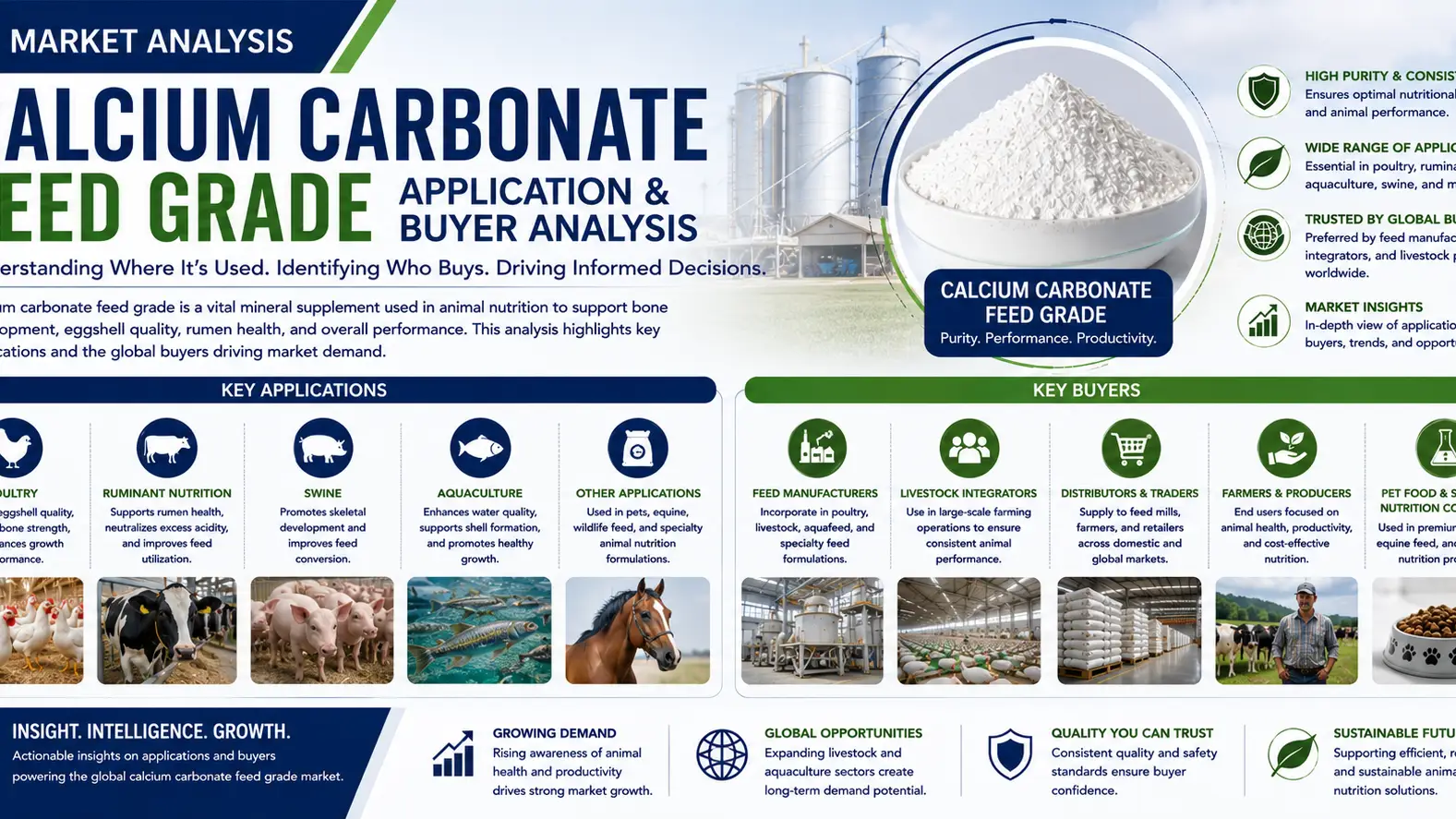
The versatility of calcium carbonate feed grade allows it to be used in numerous animal feed applications. Its broad compatibility with different formulations makes it one of the most widely traded feed minerals worldwide.
The poultry industry represents one of the largest consumers of feed-grade calcium carbonate because layer hens require substantial calcium intake for eggshell production. Swine and cattle producers also incorporate calcium carbonate into feed premixes and compound feeds.
Aquaculture producers increasingly use calcium carbonate in aquatic feed formulations to support shell formation and bone development in specific species.
According to data from the International Feed Industry Federation, global compound feed production continues to expand, creating additional demand for mineral ingredients and feed additives across major producing regions.
The market for calcium carbonate feed grade is closely connected to the expansion of the global livestock and aquaculture sectors. Rising meat consumption and increasing demand for protein-rich foods are contributing to long-term growth in feed production.
Countries in Asia-Pacific, Latin America, and Africa are experiencing rapid growth in commercial animal farming, resulting in higher consumption of feed ingredients and nutritional additives.
Market analysis published by the Organisation for Economic Co-operation and Development and the FAO projects continued growth in global animal protein demand during the coming decade.
The trend toward precision nutrition and optimized feed efficiency is also encouraging feed producers to source high-quality mineral ingredients with consistent specifications and dependable supply chains.
Purchasing decisions for calcium carbonate feed grade are influenced by technical requirements, regulatory compliance, and supply reliability. Buyers often evaluate multiple suppliers before making procurement commitments.
Typical buyers include feed manufacturers, premix producers, distributors, agricultural trading companies, and integrated livestock producers. These organizations require consistent product quality and dependable logistics support.
Procurement teams frequently compare purity levels, calcium content, particle size distribution, packaging options, and documentation related to feed safety standards.
According to industry reports from feed associations and agricultural agencies, supply chain resilience and supplier transparency have become major priorities for purchasing managers in the feed sector.
The product page on a B2B chemical marketplace supports sourcing decisions by providing technical information, specifications, and direct access to suppliers and distributors.
Successful sourcing strategies involve balancing cost competitiveness with quality assurance and long-term supply stability. International procurement teams increasingly use digital marketplaces to identify qualified suppliers.
Buyers generally seek suppliers that can provide consistent specifications, stable production capacity, and efficient export logistics. Product traceability and documentation are also becoming more important in global trade.
The increasing adoption of online procurement platforms has simplified supplier discovery and accelerated international sourcing activities in the chemical and feed industries.
According to industry reports on digital procurement trends, B2B marketplaces are becoming valuable channels for connecting feed manufacturers with global suppliers of mineral ingredients and feed additives.
Calcium carbonate feed grade remains one of the most important mineral ingredients in the animal nutrition industry due to its versatility, affordability, and broad application across livestock and aquaculture sectors.
Growing global demand for animal protein and increased focus on feed efficiency are expected to sustain demand for high-quality feed minerals in the coming years.
Manufacturers, distributors, and procurement teams can benefit from understanding market dynamics and developing reliable sourcing strategies for feed-grade calcium carbonate.
As global feed production continues to expand, digital B2B marketplaces will play an increasingly important role in connecting buyers with dependable suppliers and facilitating international trade in feed ingredients.
We're committed to your privacy. Tradeasia uses the information you provide to us to contact you about our relevant content, products, and services. For more information, check out our privacy policy.


 English
 Indonesian
 简体字
简体字
 العربية
 Español
 Français
 Português
 日本語
日本語
 한국어
한국어
 Tiếng Việt