Explore our network of country and industry based websites to access localized information, product offerings, and business services across our group.
Log in to start sending quotation requests for any product.
Don't have an account? Sign Up Here
Home Global Fish Soluble Market 2026: Applications, Buyers & Supply Trends Outlook
Trade Insights | Applications and Buyers | 14 May 2026
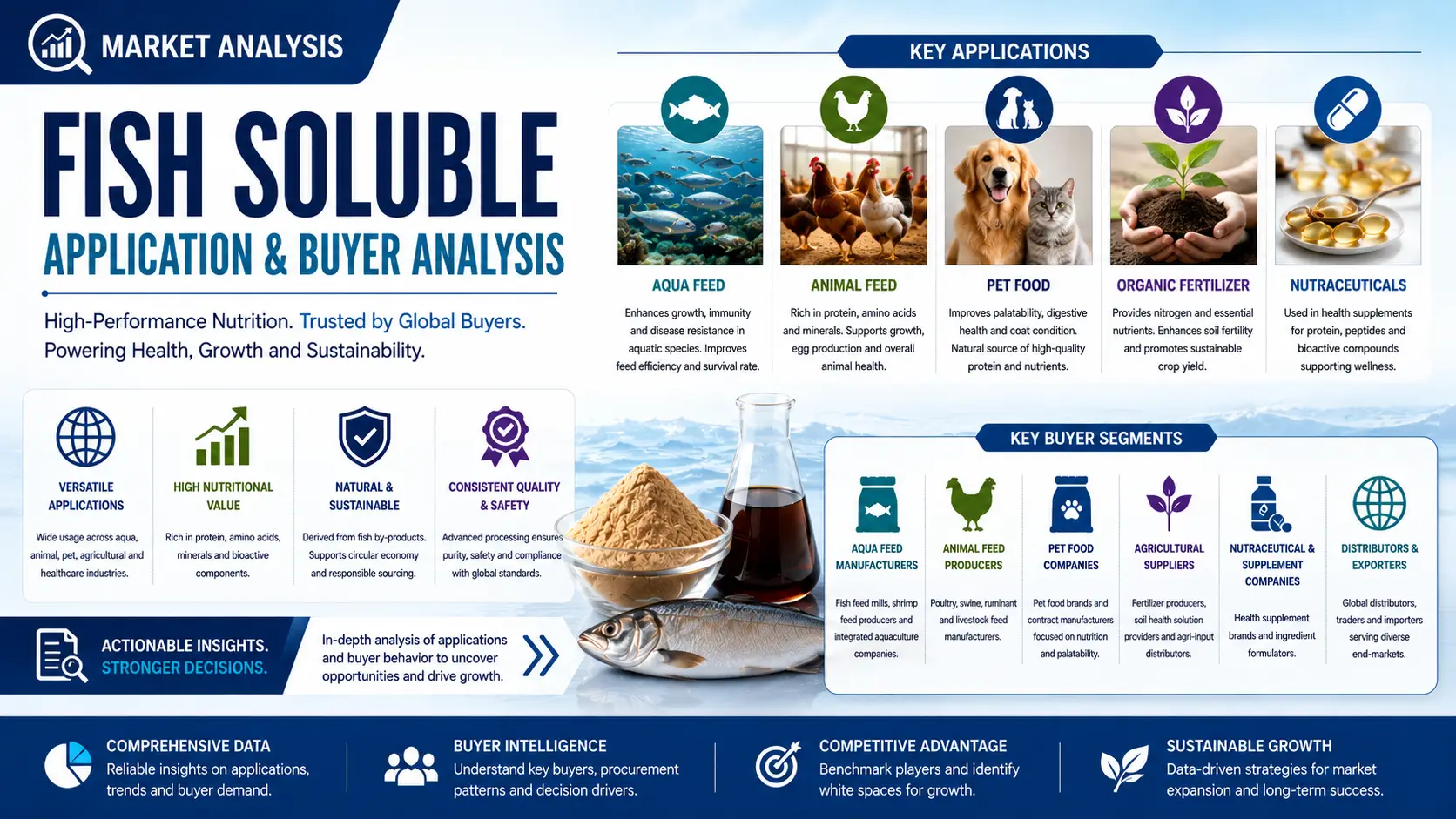
Introduction: Fish Soluble Market 2026 Overview
Expanding Demand in Aquaculture Feed Applications
Agricultural Fertilizer Adoption and Soil Biostimulant Growth
Key Buyer Segments and Global Trade Dynamics
Pricing Structure, Production Volumes, and CAGR Outlook
Conclusion
Sources
The fish soluble market in 2026 continues to evolve as a critical segment within marine-derived bio-ingredients, driven by sustainability shifts and circular economy practices in fish processing industries. Fish solubles, derived from enzymatic or thermal hydrolysis of fish by-products, are increasingly recognized for their high nutrient density and versatility across aquaculture and agriculture. Global demand is supported by a projected CAGR of 5.8%, reflecting steady industrial integration. With market pricing ranging between 450–900 USD/MT depending on protein concentration, and global output estimated at 1.2 million MT, fish solubles are becoming a strategically important platform ingredient in multiple downstream sectors.
Aquaculture remains the dominant consumption channel for fish solubles, where they are incorporated into feed formulations to enhance digestibility and growth performance. Feed manufacturers are increasingly substituting synthetic additives with marine-based hydrolysates to improve feed conversion ratios. In 2026, aquaculture-related consumption accounts for nearly half of total demand, supported by rising shrimp and salmon production across Asia and Latin America. This shift is reinforcing stable procurement contracts between processors and feed integrators.
Beyond aquaculture, fish solubles are gaining traction in organic agriculture as liquid fertilizers and soil biostimulants. Their amino acid profile and micronutrient content improve soil microbial activity and crop resilience. Farmers in North America and Europe are integrating fish-based inputs to meet organic certification standards. This segment is expanding as sustainable agriculture policies tighten, particularly in high-value horticulture and greenhouse farming systems.
The buyer landscape is highly diversified, ranging from large-scale feed manufacturers and fertilizer formulators to regional distributors and agro-input companies. Industrial buyers prioritize consistent protein concentration and traceability. Asia-Pacific remains the largest procurement hub, driven by intensive aquaculture systems, while Europe focuses on organic-certified inputs. Trade flows are increasingly influenced by integrated supply contracts and by-product utilization strategies in coastal processing hubs.
Fish soluble pricing remains sensitive to raw fish availability, energy costs, and processing efficiency. The average market range of 450–900 USD/MT reflects quality differentiation and regional supply gaps. Global production is estimated at 1.2 million MT, with moderate expansion capacity tied to fishmeal industry outputs. Over the forecast period, the sector maintains a steady 5.8% CAGR, supported by rising demand for sustainable protein alternatives and circular bioeconomy initiatives.
As industries shift toward resource-efficient production systems, fish solubles are positioned as a key bio-based input bridging aquaculture and agriculture value chains. Their multifunctional applications and rising demand across diversified buyers reinforce long-term market stability. For stakeholders seeking reliable sourcing, technical-grade consistency, and integrated supply chain solutions, Tradeasia International emerges as a strategic partner, offering global procurement support and tailored chemical distribution solutions aligned with evolving industrial requirements.
We're committed to your privacy. Tradeasia uses the information you provide to us to contact you about our relevant content, products, and services. For more information, check out our privacy policy.


 English
 Indonesian
 简体字
简体字
 العربية
 Español
 Français
 Português
 日本語
日本語
 한국어
한국어
 Tiếng Việt



















