Explore our network of country and industry based websites to access localized information, product offerings, and business services across our group.
Log in to start sending quotation requests for any product.
Don't have an account? Sign Up Here
Home Formic Acid Feed Grade Market Demand and Buyer Trends in Livestock Nutrition
Trade Insights | Applications and Buyers | 04 June 2026

Introduction to Formic Acid Feed Grade
Role of Formic Acid Feed Grade in Animal Nutrition
Key Applications Across Livestock Industries
Global Market Trends and Demand Drivers
Buyer Intent and Procurement Considerations
Sourcing Opportunities Through B2B Chemical Marketplaces
Future Outlook for Formic Acid Feed Grade
Conclusion
Sources
Formic acid feed grade is an organic acid widely used in animal nutrition to improve feed hygiene, preserve feed quality, and support digestive performance in livestock production systems. It has become an important additive for feed manufacturers seeking effective alternatives to traditional antimicrobial growth promoters.
The compound functions primarily as an acidifier and preservative within feed formulations. By reducing pH levels, formic acid helps inhibit the growth of undesirable microorganisms that can negatively affect feed quality and animal health.
The increasing emphasis on sustainable livestock production has elevated the commercial importance of feed-grade organic acids. Producers are seeking solutions that improve feed efficiency while supporting regulatory compliance.
According to technical information published by the European Food Safety Authority (EFSA), formic acid has been evaluated for its effectiveness and safety in animal feed applications, reinforcing its position within modern feed additive portfolios.
Animal nutrition specialists increasingly incorporate organic acids into feed programs to support gut health and optimize nutrient utilization. Formic acid feed grade is recognized for its contribution to maintaining a favorable gastrointestinal environment.
The acidifying effect of formic acid helps reduce microbial contamination risks during feed storage and transportation. This contributes to feed stability and supports overall feed safety objectives throughout the supply chain.
In livestock operations, maintaining microbial control is critical for improving animal performance and reducing production losses associated with contaminated feed.
Research published through scientific journals indexed by Elsevier and information from the Food and Agriculture Organization (FAO) indicate that organic acids can play an important role in feed preservation and animal nutrition management.
Growing demand for antibiotic-reduction strategies has further strengthened interest in formic acid feed grade among feed formulators and nutrition experts.
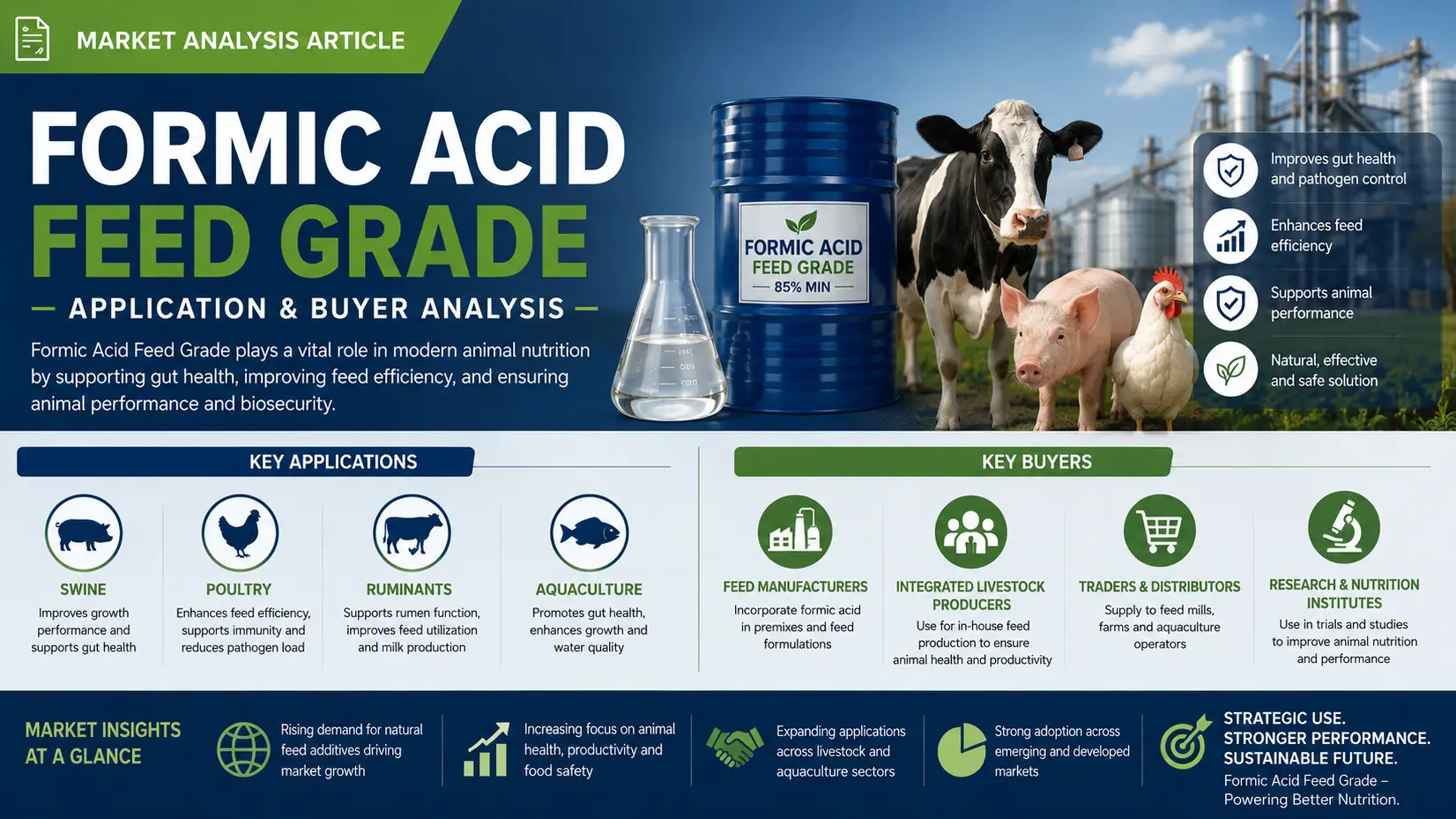
The versatility of formic acid feed grade allows it to serve multiple livestock sectors, including poultry, swine, aquaculture, and ruminant production. Its functional properties make it valuable across different feeding systems.
In poultry production, formic acid is commonly used to improve feed hygiene and support digestive health. Feed manufacturers often include it in formulations designed to enhance feed quality and reduce microbial challenges.
The swine industry utilizes formic acid to help maintain feed stability and support efficient nutrient utilization, particularly during early growth stages when digestive performance is especially important.
Aquaculture producers increasingly adopt organic acid technologies to address feed quality requirements and optimize production efficiency in intensive farming environments.
According to industry insights from the International Feed Industry Federation (IFIF) and technical publications from DSM-Firmenich and related feed additive research organizations, organic acids remain among the most widely adopted feed preservation solutions globally.
The market for formic acid feed grade is influenced by livestock expansion, feed safety regulations, and the growing adoption of specialty feed additives. Demand continues to rise across both developed and emerging agricultural economies.
Increasing global protein consumption is encouraging higher production volumes of poultry, pork, dairy, and aquaculture products. As livestock production scales, feed quality management becomes a greater priority.
Regulatory restrictions on antibiotic growth promoters in several regions have accelerated the transition toward alternative feed additives, including organic acids such as formic acid.
Market analysis published by organizations such as OECD-FAO Agricultural Outlook reports and industry assessments from Mordor Intelligence and Grand View Research highlight continued growth opportunities for feed additives supporting animal health and feed efficiency.
The Asia-Pacific region, in particular, remains a significant demand center due to expanding livestock industries and increasing investments in commercial feed manufacturing.
Purchasing decisions for formic acid feed grade involve technical, commercial, and regulatory evaluations. Procurement teams typically assess product consistency, supplier reliability, and compliance with feed industry standards.
Typical buyers include feed manufacturers, premix producers, livestock integrators, poultry companies, swine producers, aquaculture operations, distributors, and agricultural chemical traders.
Procurement professionals often compare suppliers based on purity specifications, manufacturing quality systems, logistics capabilities, packaging options, documentation support, and pricing stability.
According to guidance from feed industry associations and quality assurance frameworks promoted by organizations such as GMP+ International, traceability and product safety documentation are increasingly important procurement criteria.
A comprehensive product page helps buyers review specifications, request quotations, evaluate sourcing options, and compare suppliers more efficiently within competitive procurement environments.
Global supply chains for feed additives increasingly rely on digital sourcing channels that connect manufacturers, distributors, traders, and industrial buyers. B2B marketplaces play a growing role in procurement strategies.
Chemical marketplaces enable buyers to identify qualified suppliers, compare product offerings, and streamline supplier discovery across multiple regions. This reduces sourcing complexity and improves purchasing efficiency.
Manufacturers and distributors benefit from broader market visibility and access to international buyers seeking feed-grade chemicals for commercial operations.
Industry reports from organizations including McKinsey & Company and various digital procurement research publications indicate that B2B procurement digitization continues to reshape industrial purchasing behavior worldwide.
Platforms such as Tradeasia, Chemtradeasia, and Tradechem Marketplace help facilitate connections between chemical suppliers and procurement teams looking for dependable sourcing channels.
Long-term growth prospects for formic acid feed grade remain positive as livestock industries pursue improved feed performance, biosecurity measures, and sustainable production systems.
Innovation in feed formulation is expected to increase the use of multifunctional additives that contribute to both feed preservation and animal performance objectives.
The expansion of commercial livestock production in developing regions is likely to create additional demand for feed acidification technologies and feed safety solutions.
According to projections from FAO and international agricultural development organizations, rising global food demand will continue to drive investment in efficient livestock production systems.
As feed manufacturers seek proven and regulatory-compliant additives, formic acid feed grade is expected to remain a strategic component of modern animal nutrition programs.
Formic acid feed grade has established itself as an important feed additive within global livestock production. Its ability to support feed preservation, microbial control, and nutritional efficiency makes it valuable across poultry, swine, aquaculture, and other animal production sectors.
Growing demand for feed safety, regulatory compliance, and sustainable livestock management continues to strengthen market opportunities for suppliers and buyers. For procurement teams, evaluating reliable sourcing partners and marketplace solutions remains essential to securing consistent product quality and supply continuity in an increasingly competitive feed additive market.
https://www.efsa.europa.eu/en/topics/topic/feed-additives
https://www.fao.org/food/food-safety-quality/a-z-index/animal-feed/en/
We're committed to your privacy. Tradeasia uses the information you provide to us to contact you about our relevant content, products, and services. For more information, check out our privacy policy.


 English
 Indonesian
 简体字
简体字
 العربية
 Español
 Français
 Português
 日本語
日本語
 한국어
한국어
 Tiếng Việt