Explore our network of country and industry based websites to access localized information, product offerings, and business services across our group.
Log in to start sending quotation requests for any product.
Don't have an account? Sign Up Here
Home Millet Market Demand and Buyer Trends Across Food and Feed Industries
Trade Insights | Applications and Buyers | 10 June 2026

Understanding Millet in Global Trade
Key Industrial Applications of Millet
Market Demand and Industry Growth Drivers
Buyer Intent and Procurement Considerations
Global Supply Chain and Sourcing Opportunities
Future Outlook for Millet Markets
Conclusion
Sources
Millet is a group of small-seeded cereal grains cultivated across Asia, Africa, Europe, and North America. Known for its adaptability to dry climates and relatively low input requirements, millet has become an important agricultural commodity serving food, feed, and industrial markets.
According to the Food and Agriculture Organization (FAO), millet contributes significantly to food security in many developing economies due to its resilience and nutritional value. Commercial traders increasingly view millet as a strategic grain because of growing demand for alternative cereals and climate-resilient crops.
The product is available in several varieties including pearl millet, foxtail millet, finger millet, and proso millet. Each variety serves different end-use sectors depending on nutritional characteristics, processing requirements, and regional consumption patterns.
As global agricultural supply chains diversify, millet has gained attention from manufacturers, food processors, feed producers, and commodity traders seeking reliable grain alternatives in both domestic and export markets.
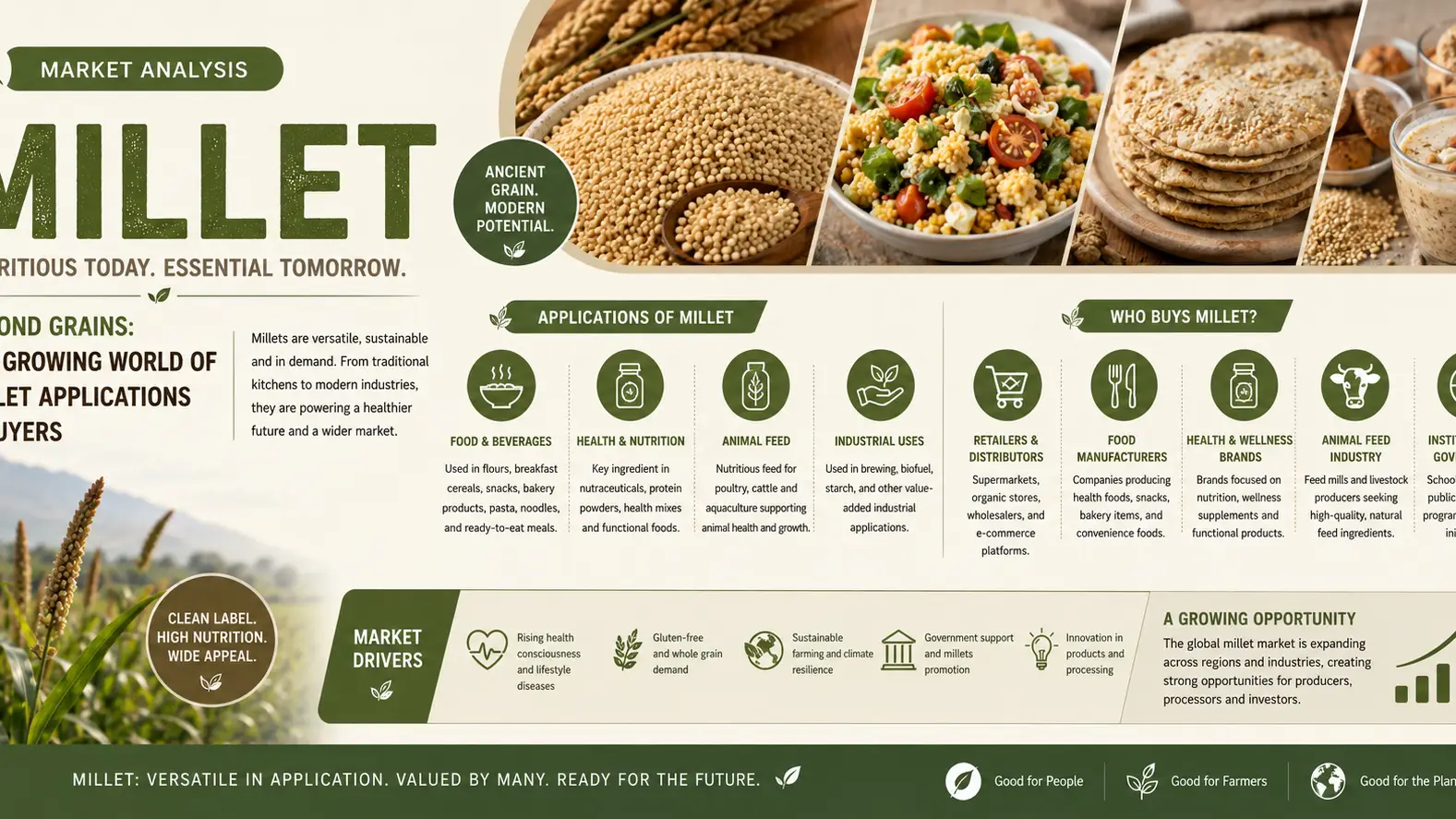
Millet serves a broad range of industries beyond traditional human consumption. Its versatility allows it to be processed into food ingredients, feed products, and specialty formulations for value-added markets.
Technical information published by the International Crops Research Institute for the Semi-Arid Tropics (ICRISAT) highlights millet's growing role in processed foods due to its fiber, mineral, and protein content. Food manufacturers use millet in breakfast cereals, bakery products, snacks, flour blends, and functional food formulations.
The feed industry also represents a major consumer segment. Millet is incorporated into poultry, livestock, and bird feed formulations because it provides a valuable source of energy and nutrients while offering flexibility in feed ingredient sourcing.
Growing consumer interest in healthy grains and sustainable agricultural products has encouraged manufacturers to develop new millet-based products, expanding industrial demand beyond traditional markets and creating opportunities for ingredient suppliers.
Global demand for millet has strengthened due to changing dietary preferences, sustainability concerns, and increasing investment in climate-resilient agriculture. These factors continue to influence procurement strategies across multiple industries.
According to market analysis published by organizations including FAO and industry research firms, demand for nutrient-dense grains has increased significantly. Millet benefits from this trend because it is recognized as a grain rich in fiber, minerals, and other beneficial nutrients.
The growing popularity of gluten-free and specialty grain products has created new market opportunities for food manufacturers seeking ingredient diversification. This trend has supported expanded millet processing capacity in several regions.
Government initiatives promoting sustainable agriculture have also contributed to market growth. Several countries encourage millet cultivation due to its lower water requirements compared with many conventional cereal crops.
As environmental and supply chain concerns remain important procurement considerations, millet is increasingly positioned as a strategic commodity within global agricultural trade networks.
Understanding buyer intent is essential for suppliers, distributors, and traders seeking to position millet effectively within B2B marketplaces. Purchasing decisions often involve technical, commercial, and supply chain evaluations.
Typical buyers include food manufacturers, cereal processors, flour mills, feed producers, agricultural traders, ingredient distributors, and export-import companies. These organizations purchase millet for use in production, blending, processing, or resale activities.
Procurement teams generally evaluate factors such as grain quality, origin, consistency, moisture content, certification requirements, packaging options, and logistics capabilities. Reliable supply availability remains a critical purchasing criterion for long-term contracts.
Buyers frequently compare suppliers based on pricing stability, product specifications, shipment reliability, and export experience. Competitive sourcing strategies often involve evaluating multiple origins to reduce procurement risks.
A well-structured product page within a B2B marketplace supports sourcing decisions by providing specification details, application information, supply capabilities, and inquiry channels that simplify supplier evaluation processes.
Millet production is concentrated in several agricultural regions that support both domestic consumption and international trade. Understanding supply dynamics helps procurement professionals identify sourcing opportunities and manage risks.
According to FAO agricultural statistics, countries such as India, Nigeria, Niger, China, and Sudan are among the world's significant millet producers. Production levels can vary based on weather conditions, cultivation practices, and government agricultural policies.
International trade flows continue to expand as food manufacturers and feed companies seek alternative grain sources. Export-oriented suppliers increasingly target markets where demand for specialty grains and sustainable agricultural ingredients is rising.
Supply chain efficiency depends on factors including harvesting cycles, storage infrastructure, transportation networks, and export logistics. These elements directly influence product availability and procurement planning.
For distributors and procurement teams, establishing relationships with experienced suppliers can improve supply reliability while supporting long-term purchasing objectives across multiple market conditions.
The long-term outlook for millet remains positive as global industries pursue diversification, sustainability, and nutritional innovation. Market participants continue to monitor developments affecting production and demand.
Industry reports from agricultural research institutions indicate growing investment in millet processing technologies and product development. These advancements may expand commercial applications across food ingredients, specialty nutrition products, and feed formulations.
Manufacturers are increasingly exploring millet as part of broader sustainability strategies. Its adaptability to challenging growing conditions aligns with efforts to improve agricultural resilience and resource efficiency.
International awareness campaigns promoting millet consumption have also increased market visibility, encouraging investment throughout the value chain from cultivation to processing and distribution.
As demand for alternative grains continues to evolve, millet is expected to remain an attractive commodity for suppliers, manufacturers, distributors, and procurement teams seeking new growth opportunities within global agricultural markets.
Millet has evolved from a traditional grain into a commercially significant agricultural commodity serving food processing, animal feed, and specialty ingredient markets. Its versatility, nutritional profile, and climate resilience support growing demand across multiple industries.
For B2B buyers, understanding market trends, application opportunities, sourcing considerations, and supply chain dynamics is essential for effective procurement planning. As global interest in sustainable and diversified grain sourcing increases, millet is well positioned to play an expanding role in international trade and industrial supply networks.
We're committed to your privacy. Tradeasia uses the information you provide to us to contact you about our relevant content, products, and services. For more information, check out our privacy policy.


 English
 Indonesian
 简体字
简体字
 العربية
 Español
 Français
 Português
 日本語
日本語
 한국어
한국어
 Tiếng Việt