Explore our network of country and industry based websites to access localized information, product offerings, and business services across our group.
Log in to start sending quotation requests for any product.
Don't have an account? Sign Up Here
Home Poultry Meal Sourcing Guide for Feed Manufacturers and Global Buyers
Trade Insights | Applications and Buyers | 17 June 2026

Understanding Poultry Meal and Its Commercial Value
Industrial Applications of Poultry Meal
Market Trends Driving Poultry Meal Demand
Key Buyers and Procurement Considerations
Global Sourcing and Supply Chain Opportunities
Future Outlook for Poultry Meal Markets
Conclusion
Sources
Poultry meal is a high-protein rendered ingredient produced from clean poultry tissues, including meat, skin, and bone, excluding feathers except in unavoidable amounts. It is widely used as a protein source in animal nutrition due to its concentrated nutrient profile and cost efficiency.
The product plays a critical role in converting poultry processing by-products into valuable feed ingredients, supporting circular economy practices within the livestock and food industries.
According to the definition published by the Association of American Feed Control Officials (AAFCO), poultry meal provides substantial amounts of digestible protein and essential amino acids for animal feed formulations.
Its nutritional composition, long storage life, and favorable economics make it a preferred ingredient for feed manufacturers seeking stable protein sources compared with more volatile alternatives.
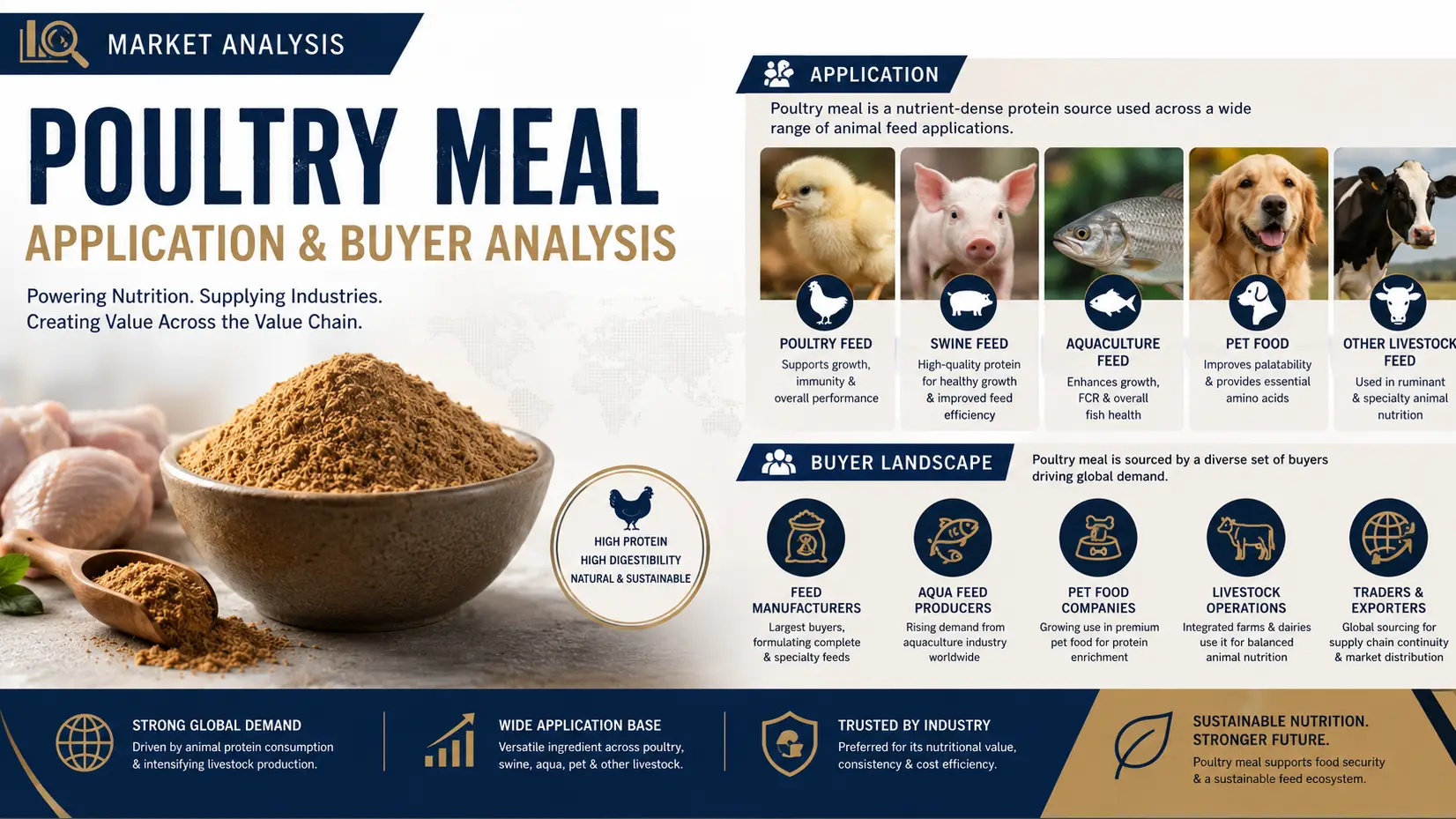
Poultry meal has become an essential ingredient across multiple animal nutrition sectors because of its high protein and energy content. Its application extends beyond conventional livestock feed and into premium pet nutrition products.
Global demand for protein ingredients has encouraged manufacturers to optimize feed formulations using rendered animal proteins that offer consistent nutritional value.
According to technical information from the Food and Agriculture Organization (FAO), rendered animal proteins such as poultry meal are extensively utilized in aquaculture feed, swine feed, and companion animal diets.
Pet food manufacturers particularly value poultry meal because it delivers concentrated protein levels and contributes to product palatability. In livestock applications, poultry meal supports growth performance and feed conversion efficiency, making it a strategic ingredient in commercial feed production.
The global poultry meal market is benefiting from increasing demand for animal protein and the expansion of commercial livestock industries worldwide. Feed producers are under pressure to secure efficient protein ingredients that balance performance and cost.
Growing pet ownership and premium pet food consumption have also created new demand channels for poultry meal producers and traders.
Market analysis published by industry research firms indicates that sustainability and circular economy initiatives are driving greater adoption of rendered proteins in feed manufacturing.
The utilization of poultry by-products reduces food processing waste and improves resource efficiency, making poultry meal increasingly attractive to feed companies pursuing environmental and economic sustainability objectives.
Poultry meal buyers span several industries, including commercial feed manufacturers, pet food producers, aquaculture companies, and livestock integrators. These organizations often purchase large volumes under long-term supply contracts.
Procurement teams evaluate suppliers carefully because ingredient consistency directly influences feed performance and production economics.
According to guidance from the International Feed Industry Federation (IFIF), buyers typically examine protein content, digestibility, microbiological safety, traceability, and compliance with feed regulations.
Buyers compare suppliers to secure reliable supply volumes, competitive pricing, and quality assurance certifications. Product specifications, origin transparency, and logistics capabilities also influence purchasing decisions. Product pages on B2B marketplaces help procurement teams efficiently compare specifications and supplier offerings before making sourcing decisions.
The poultry meal trade has become increasingly international as feed manufacturers seek diversified sourcing strategies and cost optimization. Major producing regions include North America, South America, Europe, and parts of Asia.
International traders and distributors play a significant role in connecting processors with feed manufacturers in regions experiencing protein shortages.
According to reports from the United States Department of Agriculture (USDA), global feed demand continues to increase alongside rising meat and aquaculture production.
This growth creates opportunities for manufacturers, distributors, and procurement teams to establish strategic partnerships with poultry meal suppliers. B2B marketplaces simplify supplier discovery, facilitate specification comparisons, and improve procurement efficiency in cross-border trade.
Poultry meal is expected to remain an important feed ingredient because global demand for affordable animal protein continues to expand. Feed formulators increasingly seek ingredients that combine nutritional value with sustainability credentials.
The development of premium pet nutrition products and intensified livestock production systems will likely sustain long-term demand growth.
Industry analysis from feed sector publications suggests that innovations in rendering technology and quality control systems are improving product consistency and safety standards.
As sustainability regulations and resource efficiency initiatives gain importance, poultry meal is likely to become even more valuable within global animal nutrition supply chains, presenting attractive opportunities for suppliers and international buyers.
Poultry meal occupies a strategic position in global animal nutrition industries due to its high protein concentration, broad application range, and contribution to sustainable resource utilization.
For feed manufacturers, pet food producers, distributors, and procurement teams, understanding market dynamics and sourcing opportunities can support better purchasing decisions and long-term supply security in an increasingly competitive feed ingredients market.
We're committed to your privacy. Tradeasia uses the information you provide to us to contact you about our relevant content, products, and services. For more information, check out our privacy policy.


 English
 Indonesian
 简体字
简体字
 العربية
 Español
 Français
 Português
 日本語
日本語
 한국어
한국어
 Tiếng Việt