Explore our network of country and industry based websites to access localized information, product offerings, and business services across our group.
Log in to start sending quotation requests for any product.
Don't have an account? Sign Up Here
Home Global Sunflower Meal Market Insights for Feed Buyers and Procurement Teams
Trade Insights | Applications and Buyers | 04 June 2026

Understanding Sunflower Meal in the Global Feed Industry
Industrial Applications Driving Demand for Sunflower Meal
Market Trends Shaping Global Sunflower Meal Trade
Buyer Intent and Procurement Considerations
Sourcing Strategies for Feed Manufacturers and Distributors
Global Supply Opportunities and Regional Market Outlook
Conclusion
Sunflower meal is a protein-rich co-product obtained during the extraction of oil from sunflower seeds. It has become an important feed ingredient due to its nutritional value, availability, and cost competitiveness compared with other vegetable protein sources.
The product is widely utilized in compound feed formulations for livestock and aquaculture sectors seeking reliable protein ingredients. As global feed demand increases, sunflower meal continues to attract attention from feed manufacturers looking to diversify protein supply chains.
Sunflower meal typically contains significant levels of protein, fiber, and essential nutrients that support animal growth and productivity. Technical information published by the Food and Agriculture Organization highlights sunflower-derived feed ingredients as valuable components in livestock nutrition systems.
Its commercial value is influenced by protein content, fiber levels, processing methods, and regional availability. These factors make sunflower meal an important commodity within international agricultural and feed ingredient markets.
Demand for sunflower meal is primarily driven by its role as a protein source in animal nutrition. Feed manufacturers use the ingredient to support balanced feed formulations while optimizing production costs.
Growing global consumption of meat, dairy products, and aquaculture products continues to stimulate demand for feed ingredients capable of supporting efficient animal production systems.
In poultry feed, sunflower meal is often incorporated into diets designed to support growth and feed efficiency. Technical resources from the United States Department of Agriculture identify oilseed meals as important protein inputs in commercial feed manufacturing.
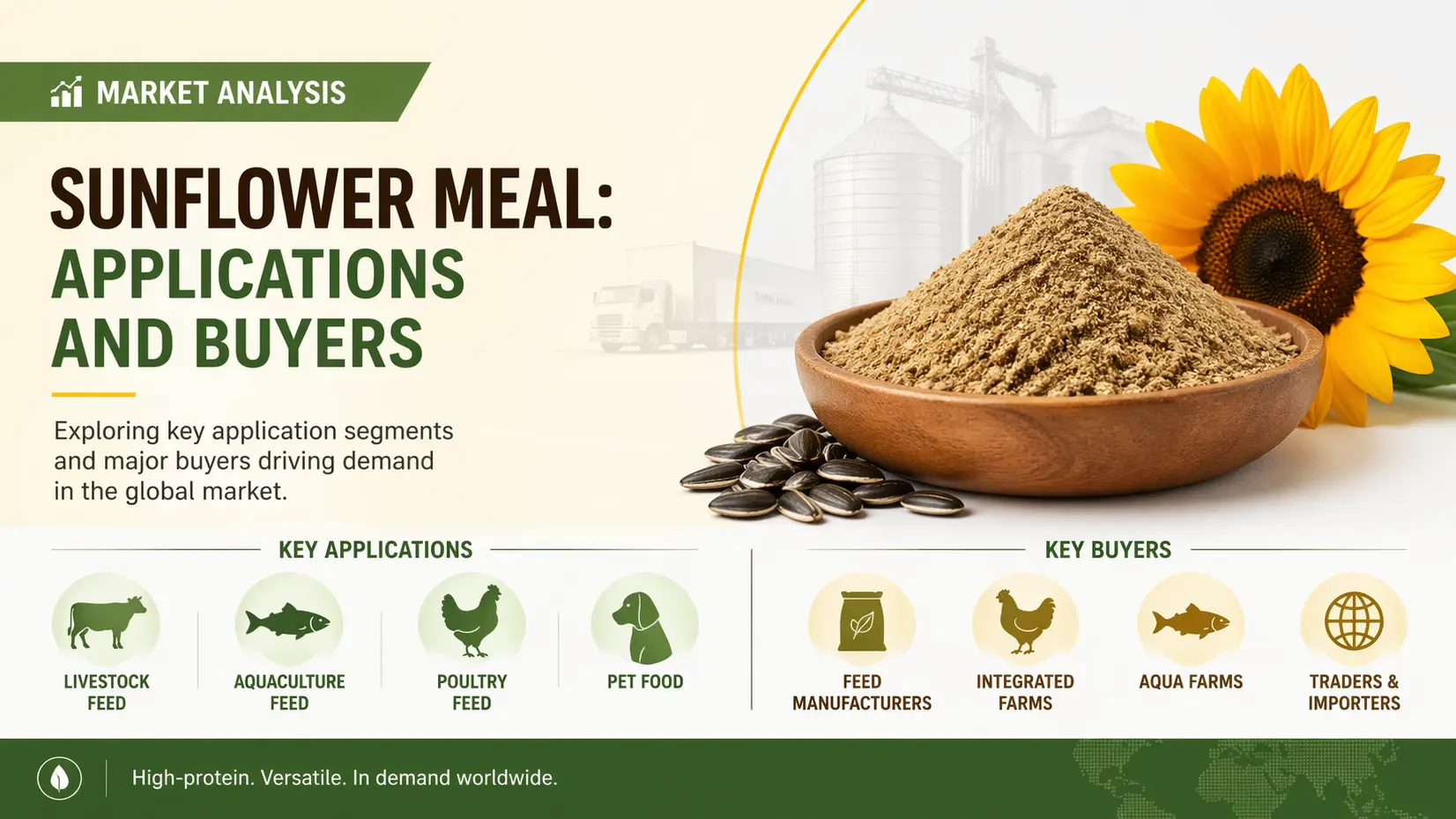
The ingredient is also used in cattle, swine, sheep, goat, and aquaculture feed formulations. Feed producers frequently evaluate sunflower meal as part of broader strategies to maintain nutritional performance while managing raw material costs.
Sustainability considerations are increasingly influencing feed ingredient selection. Sunflower meal benefits from being a co-product of vegetable oil production, supporting circular resource utilization within agricultural supply chains.
According to research published by the European Feed Manufacturers' Federation, feed producers continue to explore diverse protein sources that contribute to sustainability objectives while maintaining nutritional quality.
The global sunflower meal market is influenced by agricultural production levels, vegetable oil demand, feed consumption trends, and international trade dynamics. Market participants closely monitor sunflower seed harvests because they directly affect meal availability.
Geopolitical developments and agricultural policies can also influence trade flows and pricing conditions across major producing and consuming regions.
As feed producers seek alternatives to traditional protein meals, sunflower meal has gained greater visibility in procurement strategies. Market analysis from the Organisation for Economic Co-operation and Development and the FAO indicates continued growth in global feed demand, supporting consumption of multiple protein feed ingredients.
The trend toward diversified sourcing has encouraged buyers to evaluate sunflower meal alongside soybean meal and other vegetable protein products to improve supply resilience.
The livestock and aquaculture sectors continue to expand in emerging and developed markets. Industry data from the International Feed Industry Federation suggests long-term growth in feed production, creating sustained demand for reliable protein ingredients.
This expansion presents opportunities for suppliers, exporters, and distributors that can provide consistent sunflower meal quality and dependable logistics support.
Sunflower meal buyers typically include feed manufacturers, livestock integrators, feed distributors, agricultural traders, and aquaculture feed producers. These organizations require dependable access to protein-rich feed ingredients that support operational efficiency.
Procurement teams often compare multiple suppliers to ensure quality consistency, pricing competitiveness, and supply reliability across production cycles.
Buyers commonly assess protein content, moisture levels, fiber specifications, origin, processing standards, and shipment capabilities before making procurement decisions. Technical documentation and quality assurance records often play a central role in supplier evaluations.
According to guidance from the Global Feed LCA Institute, transparency and traceability have become increasingly important considerations for feed ingredient procurement decisions.
Supplier comparisons help procurement professionals manage risk, improve cost efficiency, and secure long-term supply agreements. Variations in quality, logistics performance, and export experience can significantly affect operational outcomes.
A comprehensive product page on a B2B marketplace supports sourcing decisions by providing technical specifications, supply information, and direct communication channels between buyers and suppliers.
Effective sourcing requires balancing quality, pricing, logistics, and long-term availability. Feed manufacturers often establish diversified procurement strategies to reduce exposure to supply disruptions.
As international trade networks expand, buyers increasingly seek suppliers capable of supporting cross-border transactions and consistent product delivery.
Reliable suppliers generally demonstrate strong quality control procedures, export capabilities, and established relationships throughout agricultural supply chains. Procurement teams often prioritize suppliers that can consistently meet contract specifications.
Industry recommendations from the FAO emphasize the importance of supplier verification and quality assurance practices when sourcing feed ingredients for commercial operations.
Digital B2B marketplaces have simplified supplier discovery and procurement workflows. Buyers can compare suppliers, evaluate product offerings, and initiate sourcing discussions through centralized platforms.
These marketplaces also improve visibility into global supply opportunities, helping procurement teams identify competitive sourcing options across multiple regions.
Sunflower meal production is closely linked to sunflower cultivation and vegetable oil processing industries. Regions with strong sunflower seed production frequently serve as major suppliers to international feed markets.
Supply opportunities continue to evolve as producers invest in processing capacity and exporters expand access to global customers.
Countries across Eastern Europe, parts of Asia, and other agricultural regions contribute significantly to global sunflower meal production. Market reports from the OECD and FAO continue to identify oilseed processing industries as important contributors to international feed ingredient trade.
These production centers provide sourcing opportunities for feed manufacturers seeking diversified procurement channels and stable supply arrangements.
Long-term demand fundamentals remain positive due to population growth, increasing protein consumption, and expansion of commercial livestock production. Feed industry stakeholders are expected to continue evaluating sunflower meal as a strategic component of feed formulations.
The combination of nutritional value, broad availability, and growing international trade participation supports a favorable outlook for global sunflower meal sourcing activities.
Sunflower meal remains a strategically important ingredient in modern animal nutrition and feed manufacturing. Its application across poultry, livestock, and aquaculture sectors continues to support demand from feed producers worldwide.
For procurement professionals, understanding market trends, supplier capabilities, quality specifications, and regional supply dynamics is essential when developing sourcing strategies. As global feed production expands, sunflower meal is expected to remain a valuable protein ingredient within international agricultural supply chains and B2B feed markets.
We're committed to your privacy. Tradeasia uses the information you provide to us to contact you about our relevant content, products, and services. For more information, check out our privacy policy.


 English
 Indonesian
 简体字
简体字
 العربية
 Español
 Français
 Português
 日本語
日本語
 한국어
한국어
 Tiếng Việt