Explore our network of country and industry based websites to access localized information, product offerings, and business services across our group.
Log in to start sending quotation requests for any product.
Don't have an account? Sign Up Here
Home Global Bakery Meal Supply Chain Guide for B2B Feed Buyers
Trade Insights | Supply Chain | 10 June 2026

Understanding Bakery Meal Composition and Supply Chain
Role of Bakery Meal in Animal Nutrition Systems
Global Market Demand Drivers and Industry Trends
Strategic Sourcing Approaches for B2B Buyers
Quality Control, Storage, and Logistics Considerations
Procurement Decision Factors and Market Conclusion
Sources
Bakery meal is a recycled feed ingredient derived from processed bakery products such as bread, biscuits, and other cereal-based foods that are no longer suitable for human consumption. It is widely recognized as an energy-rich feed component in livestock nutrition systems.
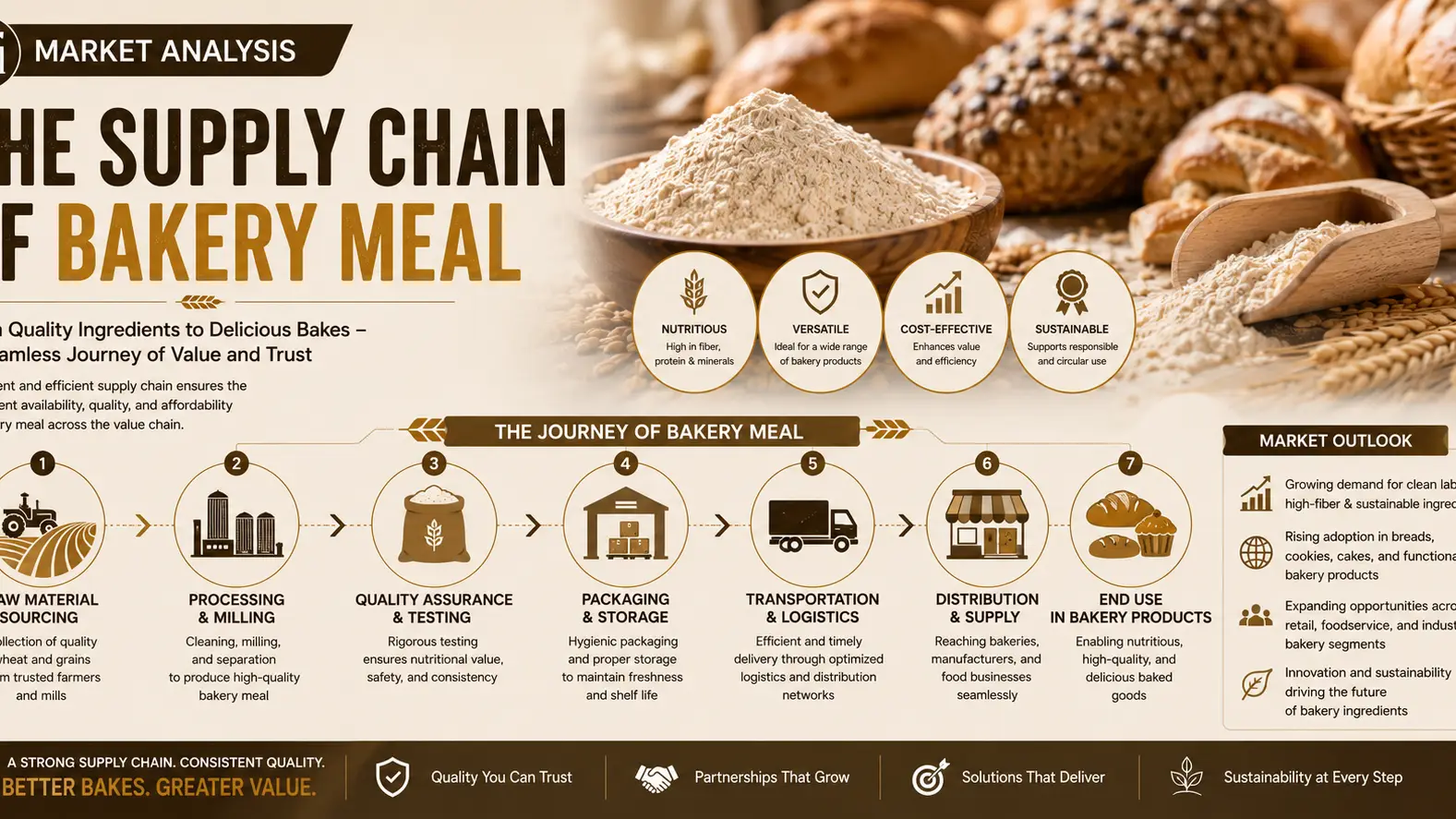
The bakery meal supply chain begins with food manufacturing surplus, retail waste streams, and industrial bakery offcuts. These materials are collected, sorted, and processed through drying and grinding operations before being converted into stable feed-grade meal.
According to the Food and Agriculture Organization (FAO), global food loss and waste streams contribute significantly to circular feed ingredient opportunities in livestock systems. Bakery byproducts are among the most commonly valorized food waste streams in industrial feed production.
In B2B trade, suppliers play a key role in aggregating bakery residues from multiple sources to ensure consistent supply volumes. This makes bakery meal a strategically important commodity within circular agriculture supply chains.
Bakery meal is primarily used as an energy-dense feed ingredient due to its high carbohydrate content. It is commonly incorporated into rations for poultry, swine, and ruminant livestock.
Within feed formulation systems, bakery meal serves as a partial substitute for maize or other cereal grains. Its digestible energy profile makes it suitable for balancing feed cost and performance efficiency.
Research referenced by the European Feed Manufacturers’ Federation (FEFAC) highlights the growing use of food industry co-products in animal feed to improve sustainability and reduce dependency on conventional grains.
Feed producers integrate bakery meal carefully to maintain protein-energy balance, ensuring that it complements other feedstock components without compromising animal health performance.
The global demand for bakery meal is increasing due to rising feed costs and the need for alternative energy sources in livestock production. This trend is strongly linked to volatility in grain markets.
Circular economy initiatives are accelerating the adoption of bakery meal as a sustainable feed input. Governments and industry bodies encourage the reuse of food waste streams for animal nutrition.
According to OECD-FAO Agricultural Outlook reports, feed ingredient diversification is a key strategy for stabilizing livestock production systems under global commodity pressure.
The market is also influenced by sustainability certifications and carbon reduction targets, pushing feed manufacturers to integrate more recycled ingredients like bakery meal into their supply chains.
B2B buyers of bakery meal prioritize consistency, moisture control, and energy value when selecting suppliers. Procurement strategies often involve long-term contracts with feed ingredient traders.
Industrial buyers assess suppliers based on processing standards, traceability systems, and supply reliability. Many prefer integrated suppliers who can guarantee year-round availability.
Based on insights from the USDA feed ingredient reports, feed manufacturers are increasingly adopting dual sourcing strategies to reduce dependency risks and ensure supply chain resilience.
Tradeasia-type marketplaces play a critical role by connecting buyers with verified suppliers across multiple regions, enabling competitive pricing and stable procurement pipelines.
Quality control is a critical factor in bakery meal procurement due to its sensitivity to moisture and microbial contamination. Proper processing ensures feed safety and nutritional consistency.
Bakery meal must be stored in dry, ventilated conditions to prevent spoilage and maintain feed quality. Moisture levels are strictly monitored to avoid mold formation during storage.
The Codex Alimentarius Commission emphasizes feed hygiene standards for processed feed materials, including proper thermal treatment and contamination control.
Logistics also play a significant role, as bakery meal is typically transported in bulk shipments. Efficient supply chains help reduce degradation risk and maintain product integrity during long-distance trade.
Procurement teams evaluate bakery meal based on cost efficiency, energy density, supply reliability, and supplier compliance with feed safety standards. These factors directly influence purchasing decisions.
Typical buyers include feed manufacturers, livestock integrators, and commodity traders seeking cost-effective energy feed ingredients. Their primary goal is optimizing feed formulation economics.
Market analysis from industry research institutions shows that buyers increasingly prioritize sustainable and traceable feed inputs to meet regulatory and ESG requirements.
In conclusion, bakery meal continues to strengthen its position as a strategic feed ingredient within global supply chains, offering both economic and sustainability advantages for B2B buyers.
We're committed to your privacy. Tradeasia uses the information you provide to us to contact you about our relevant content, products, and services. For more information, check out our privacy policy.


 English
 Indonesian
 简体字
简体字
 العربية
 Español
 Français
 Português
 日本語
日本語
 한국어
한국어
 Tiếng Việt