Explore our network of country and industry based websites to access localized information, product offerings, and business services across our group.
Log in to start sending quotation requests for any product.
Don't have an account? Sign Up Here
Home Broken Rice Sourcing Guide: Global Supply Chains and B2B Trade Opportunities
Trade Insights | Supply Chain | 02 June 2026

Understanding Broken Rice in Industrial Markets
Major Industrial Applications Driving Demand
Global Market Trends and Supply Dynamics
Buyer Intent and Procurement Considerations
Sourcing Strategies for Reliable Supply
Commercial Positioning and Future Opportunities
Conclusion
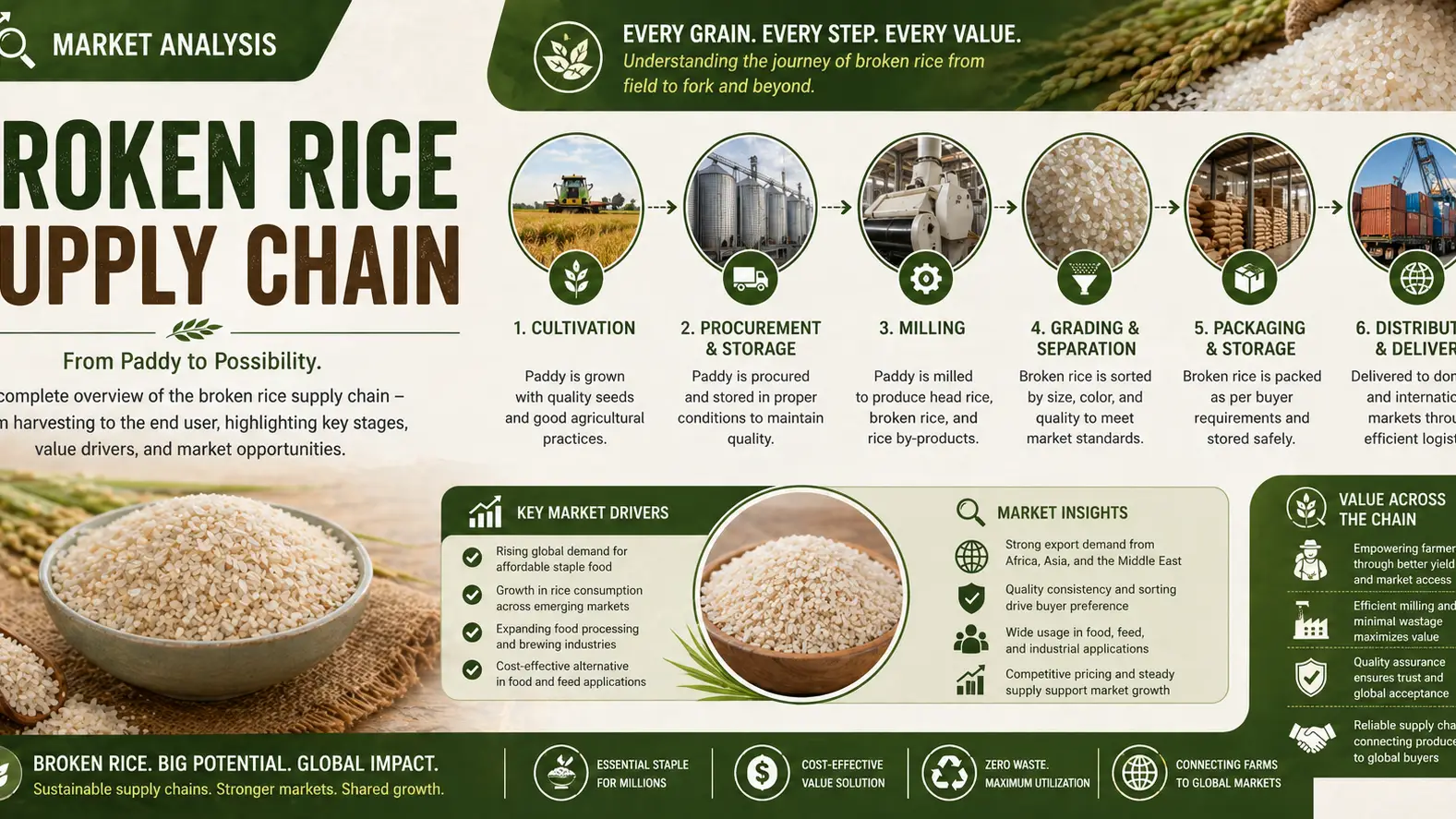
Broken rice refers to rice fragments generated during milling and processing operations. While these grains are smaller than whole rice kernels, they retain much of the same nutritional value and functionality, making them a commercially valuable agricultural commodity. The product has become an important ingredient across food manufacturing and animal nutrition sectors worldwide.
According to the Food and Agriculture Organization (FAO), rice remains one of the world's most widely traded staple crops, creating substantial secondary markets for by-products such as broken rice. Demand continues to expand as manufacturers seek cost-efficient raw materials for large-scale production.
Broken rice is valued for its affordability, availability, and versatility. Processors often utilize it as a substitute for whole rice in applications where grain appearance is not a primary requirement. This economic advantage supports strong demand among industrial buyers seeking efficient ingredient sourcing.
The United States Department of Agriculture (USDA) reports that rice processing efficiency and global production volumes continue to influence the availability of broken rice in international markets. As a result, procurement teams increasingly monitor rice-producing regions for supply opportunities and pricing trends.
Broken rice serves a diverse range of industries due to its nutritional profile and processing flexibility. One of its largest application segments is animal feed manufacturing, where it provides an energy-rich ingredient for poultry, swine, cattle, and aquaculture formulations.
Industry information published by the International Feed Industry Federation (IFIF) highlights the growing use of cereal-based feed ingredients as livestock producers seek balanced and cost-effective nutrition solutions. Broken rice is frequently incorporated into feed formulations because of its digestibility and carbohydrate content.
Food manufacturers also utilize broken rice in products such as rice flour, starch, breakfast cereals, snacks, fermented products, and beverage ingredients. Its ability to be milled efficiently makes it an attractive raw material for industrial-scale processing operations.
Research published through scientific journals indexed by Elsevier indicates that rice-derived ingredients continue to gain relevance in gluten-free and alternative food formulations. This trend supports increasing demand from food processors seeking reliable cereal ingredient sources.
Global broken rice trade is influenced by rice production volumes, export policies, feed industry demand, and food manufacturing activity. Major producing countries across Asia continue to dominate international supply, supporting exports to buyers throughout Africa, the Middle East, Europe, and Latin America.
Market assessments from the FAO indicate that fluctuations in rice harvests, weather conditions, and trade regulations can directly affect supply availability and international pricing. These factors make strategic sourcing increasingly important for procurement professionals.
The growth of livestock production and processed food manufacturing is creating additional demand for broken rice worldwide. Feed producers are continuously evaluating alternative energy ingredients, while food manufacturers seek cost-effective raw materials for value-added products.
According to OECD-FAO Agricultural Outlook publications, long-term growth in food consumption and animal protein production is expected to support continued demand for agricultural commodities such as broken rice. These trends create opportunities for suppliers, traders, and distributors operating in global markets.
Broken rice buyers typically include animal feed manufacturers, food ingredient processors, rice flour producers, livestock nutrition companies, commodity traders, and industrial distributors. These organizations often purchase in bulk and require consistent quality specifications to support production requirements.
Procurement teams evaluate several factors before purchasing, including origin, grain size distribution, moisture levels, purity, logistics capabilities, pricing stability, and supplier reliability. Quality consistency remains a critical factor because it directly affects downstream manufacturing performance.
Buyers frequently compare multiple suppliers to ensure competitive pricing and dependable delivery schedules. They also assess export experience, documentation compliance, and inventory availability before establishing long-term sourcing agreements.
Effective sourcing begins with understanding production regions and seasonal availability. Procurement teams often diversify supplier networks to reduce supply chain risks associated with harvest fluctuations, transportation disruptions, or policy changes in major exporting countries.
According to the International Trade Centre (ITC), supply chain visibility and supplier diversification have become increasingly important priorities for agricultural commodity buyers. These strategies help organizations maintain continuity while managing procurement costs.
Long-term supplier relationships can improve pricing stability, inventory planning, and logistical coordination. Buyers frequently seek partners capable of supporting recurring volume requirements and providing transparent communication throughout the procurement process.
Organizations sourcing through established B2B marketplaces can gain access to broader supplier networks, streamlined inquiry processes, and market intelligence that supports informed purchasing decisions. These advantages become particularly valuable in competitive commodity markets.
Broken rice holds significant commercial value because it bridges the needs of both food and feed industries. Its versatility enables suppliers to serve multiple buyer segments, reducing dependence on a single market and supporting broader trade opportunities.
Growing industrial demand for cost-efficient agricultural ingredients continues to strengthen the relevance of broken rice in international trade. Manufacturers increasingly incorporate it into formulations that balance performance, nutrition, and economic efficiency.
For suppliers, distributors, and traders, broken rice represents an opportunity to participate in expanding food processing and livestock nutrition markets. Reliable sourcing and quality assurance remain key differentiators in attracting long-term buyers.
Companies seeking sourcing solutions can utilize through Tradeasia, Chemtradeasia, or Tradechem Marketplace platforms to explore supplier information, submit inquiries, and evaluate procurement opportunities within the global agricultural commodity sector.
Broken rice continues to play an important role in global food processing and animal feed industries. Its affordability, nutritional value, and broad industrial applicability support growing demand from manufacturers, processors, and commodity buyers worldwide.
As global trade networks evolve, procurement teams increasingly prioritize supplier reliability, supply chain visibility, and quality consistency when sourcing agricultural ingredients. Businesses that establish strong sourcing partnerships and leverage marketplace resources can improve procurement efficiency while supporting long-term growth objectives.
We're committed to your privacy. Tradeasia uses the information you provide to us to contact you about our relevant content, products, and services. For more information, check out our privacy policy.


 English
 Indonesian
 简体字
简体字
 العربية
 Español
 Français
 Português
 日本語
日本語
 한국어
한국어
 Tiếng Việt