Explore our network of country and industry based websites to access localized information, product offerings, and business services across our group.
Log in to start sending quotation requests for any product.
Don't have an account? Sign Up Here
Home Calcium Carbonate Feed Grade Global Sourcing Guide for Animal Feed Buyers
Trade Insights | Supply Chain | 16 June 2026

Understanding Calcium Carbonate Feed Grade
Applications in Animal Nutrition and Feed Manufacturing
Global Market Trends and Demand Drivers
Supply Chain and Sourcing Considerations
Buyer Intent and Procurement Evaluation
Future Outlook for Calcium Carbonate Feed Grade
Sources
Calcium carbonate feed grade is a mineral ingredient widely used in the animal nutrition sector as a source of dietary calcium. It is typically produced from high-purity limestone and processed to meet feed safety and quality standards.
The product plays an essential role in supporting skeletal development, eggshell formation, and overall livestock productivity. Feed manufacturers often incorporate calcium carbonate into premixes and compound feed formulations because of its cost efficiency and mineral concentration.
Feed grade calcium carbonate is valued for its high calcium content, controlled particle size, and low impurity levels. These characteristics help ensure consistent nutritional performance across different animal species.
According to technical information published by the Food and Agriculture Organization (FAO), calcium supplementation remains a critical requirement in modern livestock production systems to maintain animal health and productivity.
Calcium carbonate feed grade serves as one of the most widely used mineral additives in the global feed industry. Poultry producers, dairy operations, and livestock feed manufacturers rely on the ingredient to achieve balanced mineral nutrition.
Its versatility allows it to be used in feed formulations for layers, broilers, cattle, sheep, swine, and aquaculture species. Demand continues to increase as commercial animal production expands in emerging economies.
The poultry industry represents one of the largest consumers of feed grade calcium carbonate due to the high calcium requirements for eggshell development and bone health. Dairy and cattle sectors also depend on calcium supplementation to improve productivity.
According to the National Research Council's nutrient requirements publications, calcium remains one of the most important macrominerals in animal nutrition and directly affects feed efficiency and animal performance.
Growing global demand for animal protein has significantly increased the consumption of feed ingredients and mineral additives. Expanding poultry and dairy industries in Asia, Africa, and Latin America are supporting higher demand for calcium carbonate feed grade.
The modernization of commercial farming operations and the adoption of precision nutrition strategies are encouraging feed manufacturers to source high-quality mineral ingredients with consistent specifications.
Manufacturers are increasingly focusing on traceability, product purity, and regulatory compliance. Procurement teams also prefer suppliers capable of maintaining stable supply and quality documentation.
According to market analysis published by the Organisation for Economic Co-operation and Development (OECD) and FAO agricultural outlook reports, global feed demand is expected to continue rising alongside increasing meat and dairy consumption.
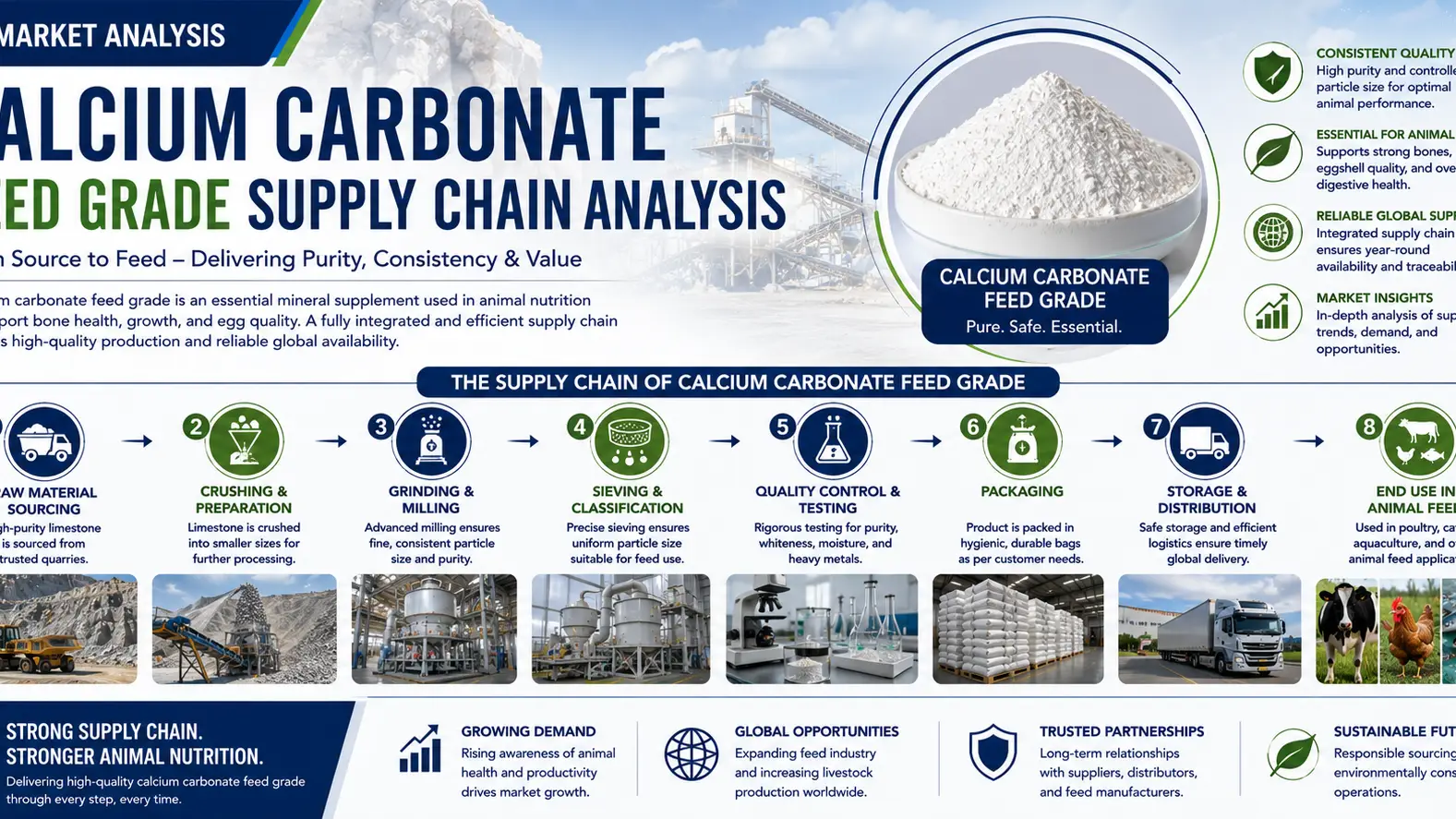
The supply chain for calcium carbonate feed grade begins with limestone mining and mineral processing before moving through distribution channels and international trade networks. Reliable sourcing depends heavily on mineral quality, production capabilities, and logistics efficiency.
Procurement teams often seek suppliers with strong quality assurance programs and export experience to minimize supply disruptions and maintain formulation consistency.
Buyers typically evaluate calcium content, particle size distribution, purity levels, certifications, packaging options, and shipping reliability before placing large-volume orders.
According to technical guidance from the International Feed Industry Federation, ingredient traceability and quality management systems have become increasingly important in global feed ingredient procurement.
The primary buyers of calcium carbonate feed grade include feed manufacturers, premix producers, livestock integrators, agricultural distributors, and trading companies. These organizations purchase the product to support nutritional formulations and ensure reliable production schedules.
Procurement teams often compare multiple suppliers to obtain competitive pricing, stable supply volumes, and documented product quality. Supplier reputation and technical support also influence purchasing decisions.
Detailed product specifications, regulatory information, and application guidance help buyers make informed sourcing decisions and reduce procurement risks.
Industry research indicates that digital B2B marketplaces increasingly serve as information hubs where buyers can compare suppliers, evaluate product offerings, and initiate procurement discussions more efficiently.
The long-term outlook for calcium carbonate feed grade remains positive due to increasing global demand for animal protein and expanding commercial livestock production. Feed manufacturers are expected to continue prioritizing cost-effective mineral ingredients with proven nutritional benefits.
Sustainability initiatives and supply chain transparency are also influencing supplier selection and procurement strategies across the feed industry.
Suppliers capable of providing consistent quality, technical documentation, and reliable international logistics will likely benefit from growing market demand and increasing cross-border trade opportunities.
Based on industry forecasts from FAO and OECD agricultural outlook studies, feed ingredient demand is expected to remain resilient as the global animal nutrition sector continues to expand.
We're committed to your privacy. Tradeasia uses the information you provide to us to contact you about our relevant content, products, and services. For more information, check out our privacy policy.


 English
 Indonesian
 简体字
简体字
 العربية
 Español
 Français
 Português
 日本語
日本語
 한국어
한국어
 Tiếng Việt