Explore our network of country and industry based websites to access localized information, product offerings, and business services across our group.
Log in to start sending quotation requests for any product.
Don't have an account? Sign Up Here
Home Deoiled Rice Bran Sourcing Guide for Feed Industry Procurement Teams
Trade Insights | Supply Chain | 02 June 2026

Understanding Deoiled Rice Bran and Its Commercial Value
Industrial Applications Driving Market Demand
Global Market Trends and Industry Outlook
Buyer Intent and Procurement Considerations
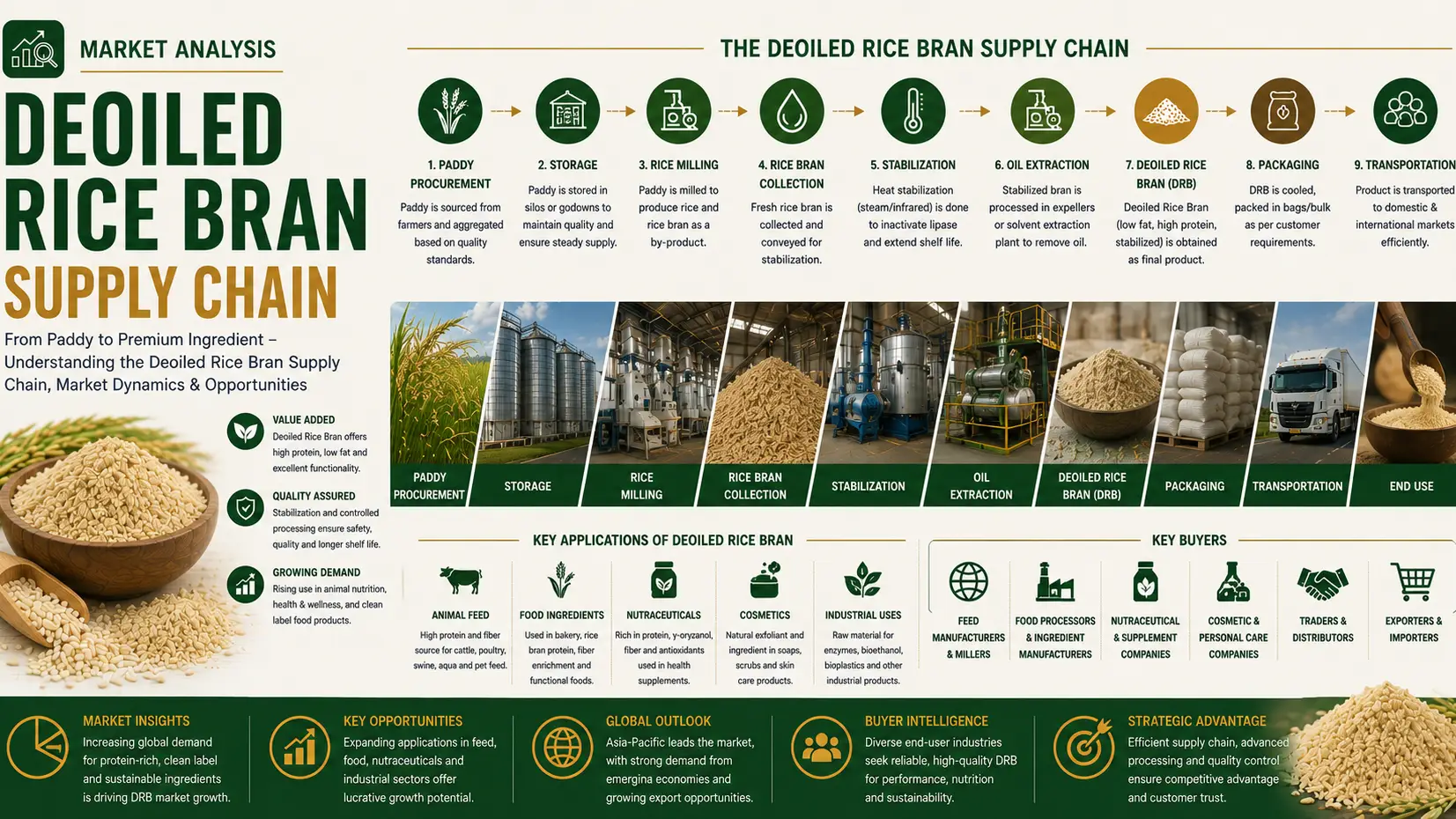
Supply Chain and Sourcing Opportunities
Commercial Positioning in the Feed Industry
Conclusion
Deoiled rice bran is a by-product obtained after extracting oil from rice bran during rice processing operations. The resulting material retains valuable nutritional components, making it an important ingredient in commercial animal feed formulations worldwide.
According to technical information published by the Food and Agriculture Organization (FAO), agricultural by-products such as rice bran play an increasingly important role in supporting sustainable livestock nutrition and resource efficiency throughout the agricultural value chain.
Deoiled rice bran contains fiber, protein, minerals, and energy-contributing nutrients that support livestock feeding programs. These characteristics have contributed to its adoption across multiple animal nutrition segments.
Its availability as a large-scale agricultural by-product also supports cost-effective feed formulation strategies, particularly in regions with significant rice production and processing industries.
The primary application of deoiled rice bran is within the animal feed industry, where it serves as a nutritional ingredient for livestock, poultry, and aquaculture feed production. Feed manufacturers often incorporate it into formulations to optimize nutritional value and cost efficiency.
According to research published by the National Center for Biotechnology Information (NCBI), rice bran-derived products continue to attract interest due to their nutritional composition and broad applicability in animal nutrition systems.
Expanding livestock production across developing and developed economies continues to support demand for alternative and sustainable feed ingredients. Deoiled rice bran has become increasingly relevant as producers seek reliable raw material sources.
The growing emphasis on feed efficiency and agricultural resource utilization further strengthens the role of deoiled rice bran in modern feed manufacturing operations.
Global feed production continues to increase alongside rising demand for meat, dairy, poultry, and aquaculture products. This trend supports greater utilization of agricultural by-products that can contribute to stable feed ingredient supply chains.
According to industry statistics from the International Feed Industry Federation (IFIF), feed manufacturers worldwide are actively exploring diversified ingredient portfolios to improve resilience and manage input costs.
Sustainability has emerged as a major factor influencing feed ingredient procurement decisions. Deoiled rice bran aligns with circular economy principles by creating additional value from rice processing streams.
As agricultural industries prioritize resource optimization and waste reduction, demand for value-added by-products such as deoiled rice bran is expected to remain strong across global markets.
Typical buyers of deoiled rice bran include feed manufacturers, livestock integrators, agricultural distributors, commodity traders, and animal nutrition companies. These organizations evaluate ingredients based on nutritional performance, supply reliability, and commercial competitiveness.
According to guidance from the United States Department of Agriculture (USDA), ingredient consistency and quality assurance remain critical factors influencing feed procurement decisions throughout international agricultural markets.
Procurement teams commonly assess nutritional specifications, moisture content, fiber levels, packaging options, logistics capabilities, and supplier reliability before purchasing deoiled rice bran.
Buyers often compare multiple suppliers to reduce procurement risks, maintain production continuity, and secure competitive pricing within fluctuating agricultural commodity markets.
Rice-producing countries across Asia remain major sources of deoiled rice bran supply. The availability of substantial rice milling infrastructure supports large-scale production and export opportunities for international buyers.
Market analysis from organizations such as FAO highlights the strategic importance of agricultural supply chains in ensuring feed ingredient availability amid evolving global demand patterns.
Reliable sourcing partnerships help manufacturers maintain inventory stability and production planning efficiency. Long-term supplier relationships can improve visibility into market conditions and future supply availability.
International buyers increasingly seek suppliers capable of supporting quality documentation, regulatory compliance, and consistent shipment schedules to strengthen procurement performance.
Deoiled rice bran occupies an important position within the global feed ingredient market because it offers nutritional functionality while supporting sustainable agricultural value chains. Its commercial relevance continues to expand alongside growth in livestock and aquaculture industries.
Industry data published by the International Feed Industry Federation suggests that feed manufacturers are increasingly prioritizing ingredient diversification to enhance supply chain resilience and operational flexibility.
Manufacturers, distributors, traders, and procurement teams benefit from access to centralized sourcing channels that improve supplier discovery and market transparency. Such platforms help buyers evaluate supply options more efficiently.
For B2B buyers, sourcing decisions increasingly depend on supplier reliability, product consistency, logistical capabilities, and commercial responsiveness, making marketplace visibility an important competitive advantage.
Deoiled rice bran continues to gain commercial importance as global feed industries seek sustainable, cost-effective, and nutritionally valuable raw materials. Its widespread use across livestock, poultry, and aquaculture sectors supports ongoing demand growth.
As feed manufacturers diversify sourcing strategies and strengthen supply chain resilience, deoiled rice bran remains a relevant ingredient for procurement teams seeking dependable feed solutions. Companies that secure reliable supply partnerships and maintain quality standards will be well-positioned to capitalize on expanding market opportunities.
We're committed to your privacy. Tradeasia uses the information you provide to us to contact you about our relevant content, products, and services. For more information, check out our privacy policy.


 English
 Indonesian
 简体字
简体字
 العربية
 Español
 Français
 Português
 日本語
日本語
 한국어
한국어
 Tiếng Việt