Explore our network of country and industry based websites to access localized information, product offerings, and business services across our group.
Log in to start sending quotation requests for any product.
Don't have an account? Sign Up Here
Home Fish Soluble Supply Chain and Global Sourcing Guide for Feed Manufacturers
Trade Insights | Supply Chain | 05 June 2026

What Is Fish Soluble and Why Is It Important?
Industrial Applications Driving Fish Soluble Demand
Global Fish Soluble Market Trends and Growth Factors
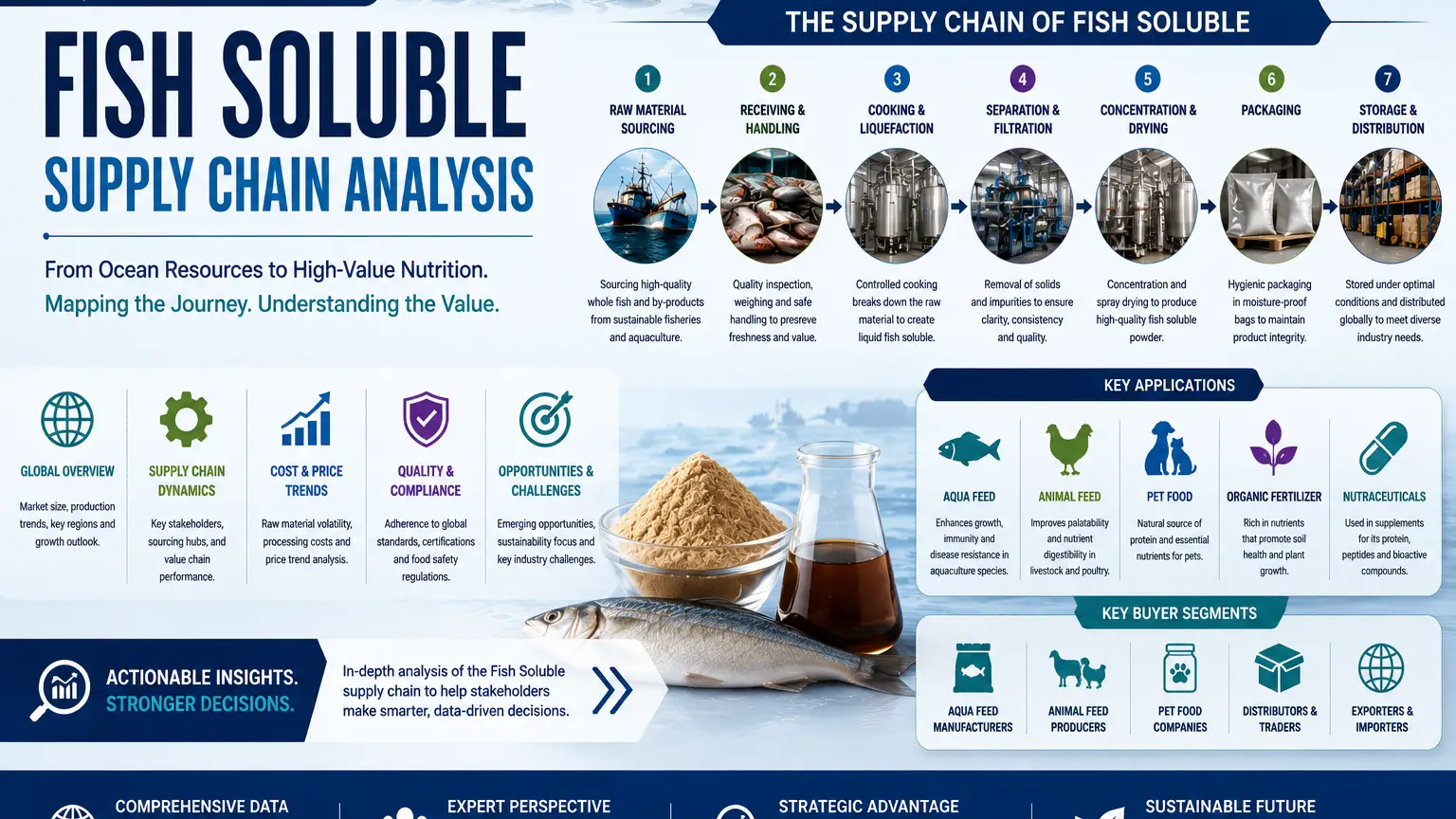
Understanding the Fish Soluble Supply Chain
Buyer Intent and Procurement Considerations
Global Sourcing Opportunities and Supplier Selection
Future Outlook for Fish Soluble Markets
Conclusion
Sources
Fish soluble is a liquid or concentrated by-product obtained during fish meal and fish oil production. It contains water-soluble proteins, amino acids, peptides, vitamins, and minerals that are recovered from fish processing streams and incorporated into feed formulations.
The growing focus on resource efficiency has increased interest in fish soluble as a value-added ingredient. According to the Food and Agriculture Organization (FAO), the utilization of fish processing by-products has become an important component of sustainable fisheries and aquaculture development.
Fish soluble is widely valued because it provides digestible nutrients that support animal growth and feed performance. The product is commonly blended into compound feeds, fish meal products, and specialty nutritional formulations.
Technical information published by the International Fishmeal and Fish Oil Organisation (IFFO) highlights the importance of marine-derived ingredients in delivering concentrated nutritional value for livestock and aquaculture applications.
Demand for fish soluble is primarily linked to its role as a nutritional ingredient in animal feed manufacturing. The product contributes proteins, amino acids, and bioactive compounds that enhance feed quality and palatability.
As feed producers seek efficient nutrient sources, fish soluble continues to attract interest from both conventional and specialized feed sectors. Industry analysis from IFFO indicates sustained demand for marine-based feed ingredients across multiple livestock and aquaculture segments.
Aquaculture producers use fish soluble to improve feed formulations for species requiring highly digestible protein sources. Fish soluble is particularly relevant in feeds designed for fish, shrimp, and other aquatic organisms.
In livestock nutrition, fish soluble can be incorporated into feed products for poultry, swine, and other production animals. Research published through scientific journals indexed by Elsevier and Springer has demonstrated the nutritional benefits of marine-derived feed ingredients in supporting animal performance.
Beyond feed manufacturing, fish soluble may also be utilized in certain agricultural formulations where organic nutrient inputs are desired. The product's nutrient profile makes it attractive for specialized applications requiring natural biological inputs.
Growing interest in circular economy practices has further expanded opportunities for fish processing by-products. According to reports from the Organisation for Economic Co-operation and Development (OECD), resource recovery strategies are becoming increasingly important across global agricultural supply chains.
The fish soluble market is closely connected to developments in aquaculture production, seafood processing, and animal nutrition industries. As global demand for protein continues to increase, feed manufacturers are seeking efficient ingredients that support productivity.
Market assessments from the FAO consistently identify aquaculture as one of the fastest-growing food production sectors, creating long-term demand for marine-based feed ingredients and related nutritional products.
The expansion of commercial aquaculture has become one of the strongest demand drivers for fish soluble. Producers require nutritionally balanced feed formulations capable of supporting efficient growth rates and feed conversion ratios.
FAO fisheries reports indicate that aquaculture output continues to increase globally, particularly across Asia-Pacific markets where feed ingredient consumption remains substantial.
Sustainability considerations are influencing purchasing decisions throughout feed supply chains. Fish soluble supports resource optimization by utilizing materials generated during fish processing operations.
Industry publications from IFFO emphasize that improved utilization of marine by-products can contribute to more sustainable production systems while generating additional economic value for seafood processors.
The fish soluble supply chain begins with seafood processing and fish reduction operations where raw fish materials are transformed into fish meal, fish oil, and soluble fractions. The availability of raw materials directly influences production volumes and market supply.
Supply conditions often vary according to seasonal fishing activity, regional fisheries management practices, and seafood processing output. Government fisheries agencies regularly monitor these factors because they affect marine ingredient markets.
After separation from fish meal and fish oil production streams, fish soluble undergoes concentration and stabilization processes to ensure quality and usability. Processing standards are important because nutritional consistency influences buyer acceptance.
Technical guidance from feed industry organizations highlights the importance of quality control measures related to protein content, moisture levels, storage stability, and product traceability.
Fish soluble is traded internationally through networks of manufacturers, exporters, distributors, and feed ingredient suppliers. Major production regions are often located near significant fishing and seafood processing centers.
Global trade data published by organizations such as the United Nations Conference on Trade and Development (UNCTAD) demonstrates the growing importance of efficient logistics and supply chain management in agricultural commodity markets.
Fish soluble buyers typically include feed manufacturers, aquaculture companies, livestock nutrition firms, feed premix producers, agricultural distributors, and commodity trading organizations. These buyers seek reliable supply and consistent product performance.
Procurement teams increasingly evaluate both nutritional value and supply reliability when selecting marine-derived feed ingredients. Purchasing decisions are often influenced by long-term production planning and market demand forecasts.
Buyers commonly assess product specifications, protein content, nutrient composition, origin, processing methods, certifications, and traceability systems. These criteria help determine suitability for specific feed applications.
Industry guidance from feed associations suggests that quality assurance documentation and supply transparency have become increasingly important during supplier qualification processes.
Procurement professionals compare suppliers to secure competitive pricing, consistent quality, dependable logistics, and long-term availability. Supply disruptions can significantly affect feed manufacturing operations and production schedules.
Product pages on B2B marketplaces help buyers compare technical specifications, sourcing regions, supplier capabilities, and commercial terms, enabling more informed purchasing decisions.
International sourcing has become a strategic priority for companies seeking stable access to fish soluble. Buyers often diversify sourcing channels to reduce supply risks and improve procurement flexibility.
Market intelligence published by global commodity research organizations highlights the importance of supplier diversification in managing volatility across agricultural and feed ingredient markets.
When assessing suppliers, buyers frequently examine production capacity, export experience, quality management systems, and supply chain transparency. Strong supplier relationships can improve procurement efficiency and reduce operational risk.
Third-party certifications and documented quality procedures are often used as indicators of supplier reliability, particularly for companies serving regulated feed markets.
Digital B2B marketplaces have simplified the process of identifying qualified fish soluble suppliers across multiple regions. These platforms connect manufacturers, distributors, traders, and procurement teams through centralized sourcing channels.
Industry research from leading market intelligence providers suggests that digital procurement solutions continue to gain adoption as companies seek greater visibility and efficiency in supply chain management.
The long-term outlook for fish soluble remains closely tied to aquaculture growth, feed innovation, and sustainability initiatives. Demand is expected to benefit from continued expansion of protein production industries worldwide.
According to FAO projections, aquaculture will continue to play a major role in meeting future global food demand, supporting the market potential of marine-derived feed ingredients.
Advances in feed science are creating new opportunities for specialized nutritional ingredients. Fish soluble may become increasingly integrated into formulations designed to optimize animal health, feed efficiency, and production performance.
Research institutions and feed technology companies continue to explore innovative approaches that maximize the value of marine-derived nutrients.
Future competitiveness will depend on efficient sourcing strategies, reliable production systems, and transparent supply chains. Buyers are expected to prioritize suppliers capable of demonstrating consistent quality and operational stability.
Market development efforts focused on sustainability, traceability, and resource utilization are likely to strengthen the commercial position of fish soluble within global feed ingredient markets.
Fish soluble has established itself as a valuable marine-derived ingredient within global feed and aquaculture industries. Its nutritional benefits, combined with increasing interest in sustainable resource utilization, continue to support commercial demand.
As aquaculture production expands and feed manufacturers seek reliable nutritional inputs, fish soluble is expected to remain an important component of international feed ingredient supply chains. Companies that prioritize quality sourcing, supplier evaluation, and supply chain resilience will be best positioned to capitalize on future market opportunities.
We're committed to your privacy. Tradeasia uses the information you provide to us to contact you about our relevant content, products, and services. For more information, check out our privacy policy.


 English
 Indonesian
 简体字
简体字
 العربية
 Español
 Français
 Português
 日本語
日本語
 한국어
한국어
 Tiếng Việt