Explore our network of country and industry based websites to access localized information, product offerings, and business services across our group.
Log in to start sending quotation requests for any product.
Don't have an account? Sign Up Here
Home Global Folic Acid Supply Chain and B2B Procurement Outlook
Trade Insights | Supply Chain | 11 June 2026
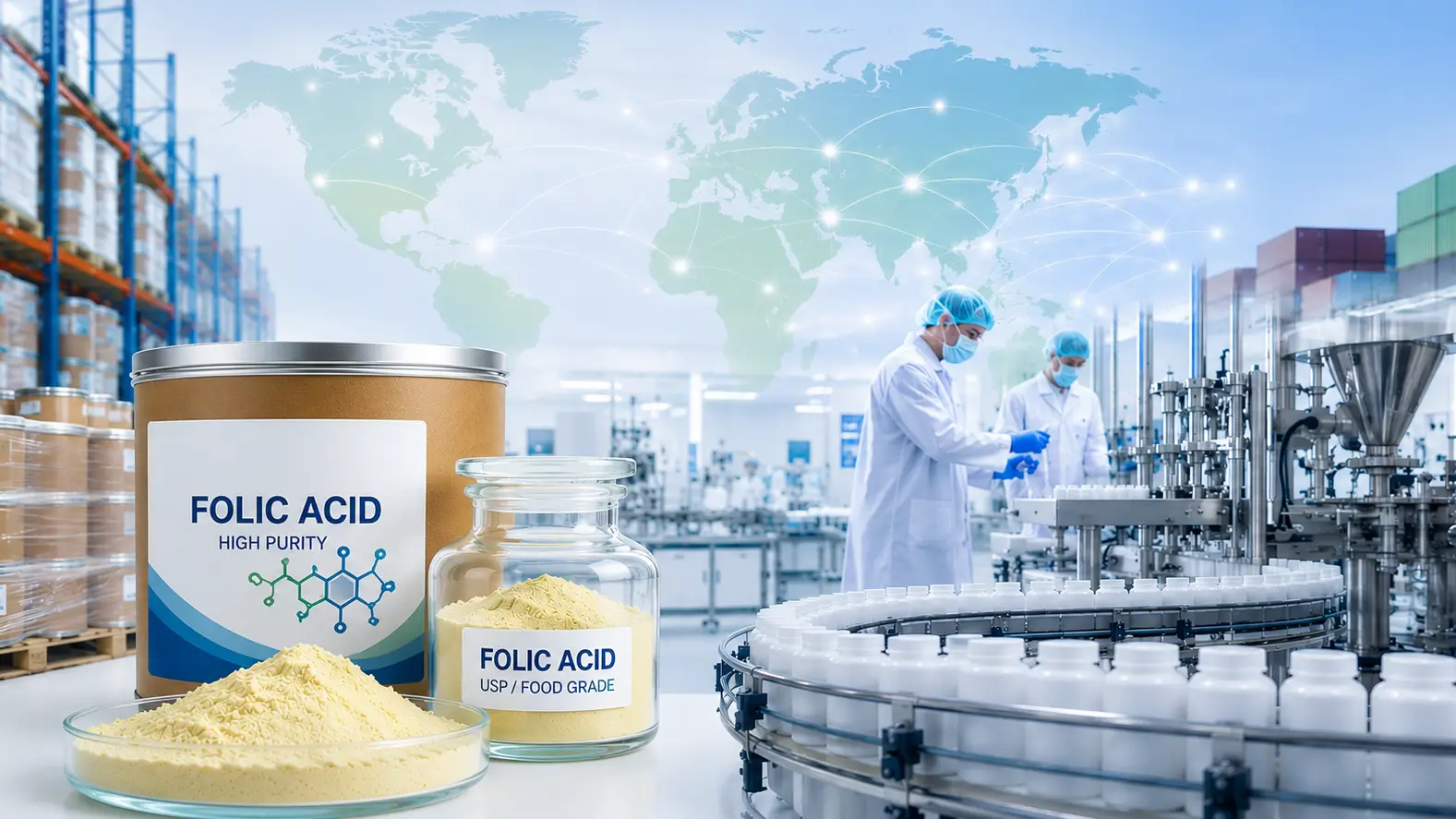
Global Folic Acid Supply Chain Overview
Raw Material Production and Manufacturing Pathways
Pharmaceutical Industry Demand and Applications
Food Fortification and Nutrition Market Expansion
Animal Feed and Industrial Usage Trends
B2B Sourcing Strategy and Procurement Considerations
Future Market Outlook and Risk Factors
Sources
The global folic acid supply chain is structured around a limited number of chemical manufacturing hubs, primarily concentrated in Asia, Europe, and North America. These production clusters supply downstream pharmaceutical, food, and feed industries through a highly interconnected distribution network. According to WHO nutritional supplementation frameworks, folic acid remains a critical micronutrient requiring stable global availability to support public health programs.
Manufacturers typically operate in bulk synthesis facilities, where intermediates are processed under controlled pharmaceutical-grade standards. Distribution channels then extend through traders, chemical distributors, and regional warehouses that ensure continuity of supply to industrial buyers. The supply chain is highly sensitive to regulatory compliance and raw material stability.
Regional dependency plays a major role in pricing and availability fluctuations. Emerging markets rely heavily on imports, while developed regions maintain partial self-sufficiency through domestic production. Industry analysis from OECD health supply reports highlights that micronutrient supply chains are vulnerable to logistics disruptions and regulatory tightening.
This structure creates opportunities for B2B suppliers who can ensure consistent cross-border logistics and multi-origin sourcing strategies. Buyers increasingly prefer suppliers with diversified manufacturing footprints to reduce procurement risk.
For procurement teams, folic acid is not just a commodity but a regulated nutritional ingredient requiring traceability. Supply chain transparency has become a key purchasing criterion, especially for pharmaceutical-grade applications. Companies are prioritizing suppliers that can demonstrate compliance with GMP and international pharmacopeia standards.
This elevates the role of integrated chemical marketplaces in bridging manufacturers and end-users efficiently.
Folic acid is synthesized through multi-stage chemical processes involving pteridine derivatives, para-aminobenzoic acid, and glutamic acid coupling. According to technical documentation from the U.S. National Library of Medicine, the synthesis process requires strict control of reaction conditions to ensure purity and stability.
Industrial production is typically batch-based, allowing manufacturers to maintain quality consistency across large volumes. The complexity of synthesis contributes to its classification as a high-value specialty chemical.
Manufacturing facilities must comply with pharmaceutical-grade standards such as USP, EP, or JP specifications depending on the destination market. These standards regulate impurity limits, assay values, and microbial contamination thresholds.
Quality assurance systems are integrated into production lines to ensure batch traceability. This is essential for buyers in regulated industries such as pharmaceuticals and infant nutrition.
As demand increases, manufacturers are scaling production capacities while maintaining regulatory compliance. Industry insights from Chemical & Engineering News highlight that micronutrient demand stability is encouraging investment in expanded synthesis facilities.
However, scaling is constrained by raw material availability and environmental regulations, making supplier diversification essential.
Folic acid plays a crucial role in pharmaceutical formulations, particularly in prenatal supplements and anemia treatments. The World Health Organization emphasizes its importance in preventing neural tube defects during pregnancy.
Pharmaceutical companies incorporate folic acid into single-dose and multivitamin formulations, requiring highly purified raw material grades.
The pharmaceutical sector imposes strict regulatory frameworks on folic acid procurement. Buyers must ensure compliance with GMP and pharmacopeial standards before integration into finished dosage forms.
Regulatory agencies such as the FDA and EMA continuously monitor ingredient quality, influencing global sourcing decisions.
Preventive healthcare trends are driving increased consumption of folic acid-based supplements. Rising awareness of micronutrient deficiencies has expanded demand across both developed and emerging markets.
This has led to stable long-term procurement contracts between manufacturers and pharmaceutical distributors.
Folic acid is widely used in food fortification programs aimed at reducing micronutrient deficiencies. According to the Food and Agriculture Organization (FAO), fortification of staple foods like flour is a key global health strategy.
Governments across multiple regions mandate or encourage folic acid fortification to improve population health outcomes.
Food manufacturers incorporate folic acid into processed foods, beverages, and nutritional products. This requires stable, food-grade supply chains capable of meeting large-scale production needs.
Consistency in dosage and stability during processing are critical factors influencing supplier selection.
Rising consumer awareness of nutrition has increased demand for fortified foods. This trend supports long-term growth in folic acid consumption across retail and industrial segments.
Food companies are increasingly collaborating with chemical suppliers to secure reliable micronutrient inputs.
Folic acid is an important additive in animal feed formulations, particularly for poultry and swine. It supports growth performance, reproductive health, and metabolic function.
According to research from the European Food Safety Authority (EFSA), vitamin supplementation in animal feed significantly improves productivity outcomes.
Feed producers require cost-efficient and stable folic acid supply in bulk quantities. Quality consistency is essential to ensure uniform distribution across feed batches.
This creates strong demand for industrial-grade suppliers capable of large-scale delivery.
The global expansion of meat and dairy production is driving increased demand for feed additives. Folic acid remains a key micronutrient in optimizing livestock health and output.
This positions it as a stable input in the broader agricultural supply chain.
B2B buyers evaluate folic acid suppliers based on certification, production capacity, and regulatory compliance. Consistency in quality and documentation is critical for long-term procurement contracts.
International buyers also assess logistics capabilities and lead time reliability before selecting suppliers.
Pricing for folic acid is influenced by raw material costs, energy prices, and global demand fluctuations. Buyers often adopt long-term contracts to stabilize procurement costs.
Spot purchasing is used primarily for short-term demand balancing in flexible supply chains.
Digital B2B marketplaces streamline sourcing by connecting buyers with verified manufacturers and distributors. These platforms improve transparency and reduce procurement complexity.
They also enable cross-regional sourcing, allowing buyers to diversify risk and improve supply resilience.
Emerging economies are expected to contribute significantly to future demand expansion.
Potential risks include raw material shortages, regulatory changes, and logistics disruptions. These factors can significantly impact availability and pricing stability.
Supply chain resilience is becoming a top priority for procurement organizations.
Manufacturers are investing in capacity expansion and process optimization to meet future demand. This includes modernization of chemical synthesis facilities and improved sustainability practices.
These investments are expected to strengthen long-term global supply stability.
https://www.who.int
https://www.efsa.europa.eu
https://www.fda.gov
We're committed to your privacy. Tradeasia uses the information you provide to us to contact you about our relevant content, products, and services. For more information, check out our privacy policy.


 English
 Indonesian
 简体字
简体字
 العربية
 Español
 Français
 Português
 日本語
日本語
 한국어
한국어
 Tiếng Việt



















