Explore our network of country and industry based websites to access localized information, product offerings, and business services across our group.
Log in to start sending quotation requests for any product.
Don't have an account? Sign Up Here
Home Global L-Arginine Supply Chain Market 2026: Logistics, Capacity & Pricing
Trade Insights | Supply Chain | 13 May 2026
Introduction: Industrial Flow of L-Arginine in the 2026 Bioeconomy
Production Concentration and Fermentation Scaling
Feedstock Dependency and Upstream Integration
Logistics, Trade Flows and Regional Hubs
Pricing Dynamics and Demand Pressure
Conclusion
Sources
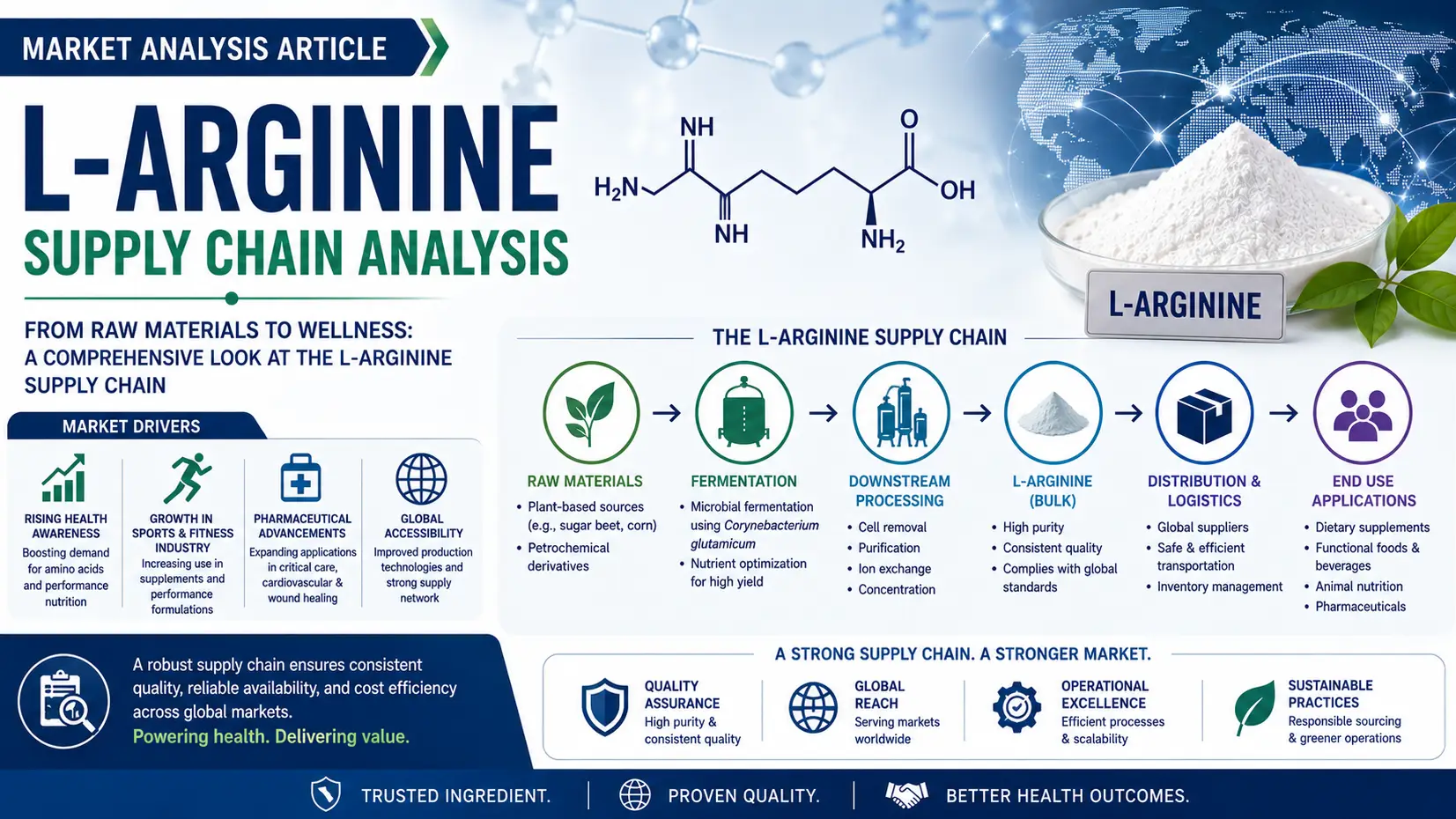
L-arginine, a semi-essential amino acid widely used in pharmaceuticals, nutraceuticals, and animal feed, has strengthened its position as a strategic platform chemical in 2026. The supply chain is shaped by fermentation-led production, Asia-centric manufacturing, and stricter global quality compliance. With demand expanding at an estimated 6.5% CAGR, global production capacity is near 120,000 MT, while export prices range between $2,500–$3,200/MT depending on purity and contract structure. Integration across biotech producers and downstream formulators is increasingly defining market stability and procurement reliability across global industries.
Production remains dominated by microbial fermentation using glucose-derived feedstocks, with China contributing over 65% of global output. In 2026, capacity is around 120,000 MT, with utilization rates of 78–82%. Efficiency gains from strain engineering are pushing yields above 90%, improving cost competitiveness. Expansion in Southeast Asia is gradually diversifying supply risk, yet leading producers still control most export volumes, reinforcing a highly consolidated manufacturing landscape across the amino acid value chain.
L-arginine supply chains depend heavily on corn-derived glucose, accounting for nearly 70% of production costs. Volatility in agricultural inputs has driven backward integration into starch and glucose processing. This has stabilized production costs near $1,900–$2,300/MT, even amid raw material fluctuations. Vertical integration is now a key strategy for securing long-term supply reliability and protecting margins in export-focused operations, particularly among large-scale Asian manufacturers.
Global trade flows are centered in Asia, with China and Japan as major exporters supplying North America and Europe. Lead times average 18–25 days, though freight volatility still affects contract stability. Regulatory compliance for USP and feed-grade standards remains a key barrier in cross-border movement. Regional warehousing in Europe and the UAE is increasingly used as a buffer strategy to reduce supply disruptions and improve downstream distribution resilience.
Pricing remains driven by pharmaceutical and feed-grade demand, with 2026 spot ranges between $2,500–$3,200/MT. Growth in sports nutrition and clinical applications supports a steady 6.5% CAGR in value terms. However, rising energy and compliance costs are compressing margins, prompting suppliers to adopt long-term contracts and hedging strategies to stabilize revenue streams across volatile cycles in global amino acid markets.
L-arginine continues to serve as a key platform chemical across nutrition and pharmaceutical value chains. As supply networks become more complex, buyers increasingly rely on integrated sourcing partners to ensure continuity and quality assurance. In this environment, Tradeasia International provides coordinated procurement solutions, global logistics support, and access to diversified amino acid portfolios, helping industries mitigate risk and maintain stable supply in an increasingly tight and competitive global market.
We're committed to your privacy. Tradeasia uses the information you provide to us to contact you about our relevant content, products, and services. For more information, check out our privacy policy.


 English
 Indonesian
 简体字
简体字
 العربية
 Español
 Français
 Português
 日本語
日本語
 한국어
한국어
 Tiếng Việt



















