Explore our network of country and industry based websites to access localized information, product offerings, and business services across our group.
Log in to start sending quotation requests for any product.
Don't have an account? Sign Up Here
Home Sunflower Meal: Market Trends and Procurement Insights for Feed Buyers
Trade Insights | Supply Chain | 18 June 2026

What Is Sunflower Meal and Why Is It Important?
Industrial Applications Driving Sunflower Meal Demand
Global Market Trends and Supply Outlook
Supply Chain Structure and Trade Dynamics
Buyer Intent and Procurement Considerations
Choosing Reliable Sunflower Meal Suppliers
Future Opportunities in the Sunflower Meal Market
Conclusion
Sources
Sunflower meal is a protein-rich byproduct obtained during the extraction of oil from sunflower seeds. After oil processing, the remaining material is processed into meal, which is widely used as a nutritional ingredient in animal feed formulations. Its balance of protein, fiber, and minerals makes it a valuable feed component across livestock industries.
The product is especially important in regions where feed manufacturers seek alternatives to soybean meal. As feed costs continue to influence agricultural profitability, sunflower meal offers a competitive ingredient option for nutrition programs.
Technical information from the Food and Agriculture Organization (FAO) identifies sunflower meal as an established protein source used in livestock feeding systems worldwide. The product contains varying protein levels depending on dehulling practices and processing methods.
Its commercial importance extends beyond nutrition because it provides flexibility in feed formulation. Buyers often evaluate protein concentration, fiber content, moisture levels, and consistency before incorporating sunflower meal into feed production.
According to agricultural industry data published by the United States Department of Agriculture (USDA), oilseed meal demand continues to be supported by growth in global livestock production and feed consumption.
For traders and procurement teams, sunflower meal represents a strategically important commodity within the broader oilseed processing value chain due to its availability and cost competitiveness.
The majority of sunflower meal production is consumed by the animal nutrition sector. Feed manufacturers use it as a source of protein and energy for livestock diets, supporting growth, productivity, and overall feed efficiency.
Demand is influenced by developments in poultry, dairy, beef, aquaculture, and swine industries, all of which require consistent feed ingredient supplies.
According to research published by academic and animal nutrition institutions, sunflower meal is commonly incorporated into poultry feed, cattle feed, dairy rations, and swine nutrition programs depending on nutritional requirements.
The poultry industry represents a significant consumer segment because feed formulations require reliable protein sources that help maintain production performance. Dairy and beef operations also utilize sunflower meal to complement forage-based diets.
In some markets, aquaculture feed manufacturers are evaluating alternative plant-based protein ingredients, creating additional opportunities for sunflower meal utilization.
As livestock production expands globally, the need for diversified protein ingredients continues to support industrial demand for sunflower meal across multiple feed sectors.
Sunflower meal demand is closely linked to global oilseed production, livestock expansion, and feed manufacturing activity. Production levels are influenced by sunflower seed harvest volumes and processing capacity in major producing countries.
International trade patterns can affect availability, pricing, and procurement decisions, particularly during periods of agricultural supply disruption.
Market analysis published by the USDA and international agricultural trade organizations identifies Eastern Europe, the Black Sea region, and parts of South America as major contributors to global sunflower production and processing.
Countries with significant sunflower crushing industries play a central role in determining export availability. Production fluctuations caused by weather conditions, logistics challenges, or geopolitical factors can influence market conditions.
Growing demand for vegetable oils indirectly supports sunflower meal output because higher oilseed processing volumes generate additional meal supply for feed markets.
Industry observers continue to monitor investments in agricultural processing infrastructure, which may improve long-term availability and supply reliability for international buyers.
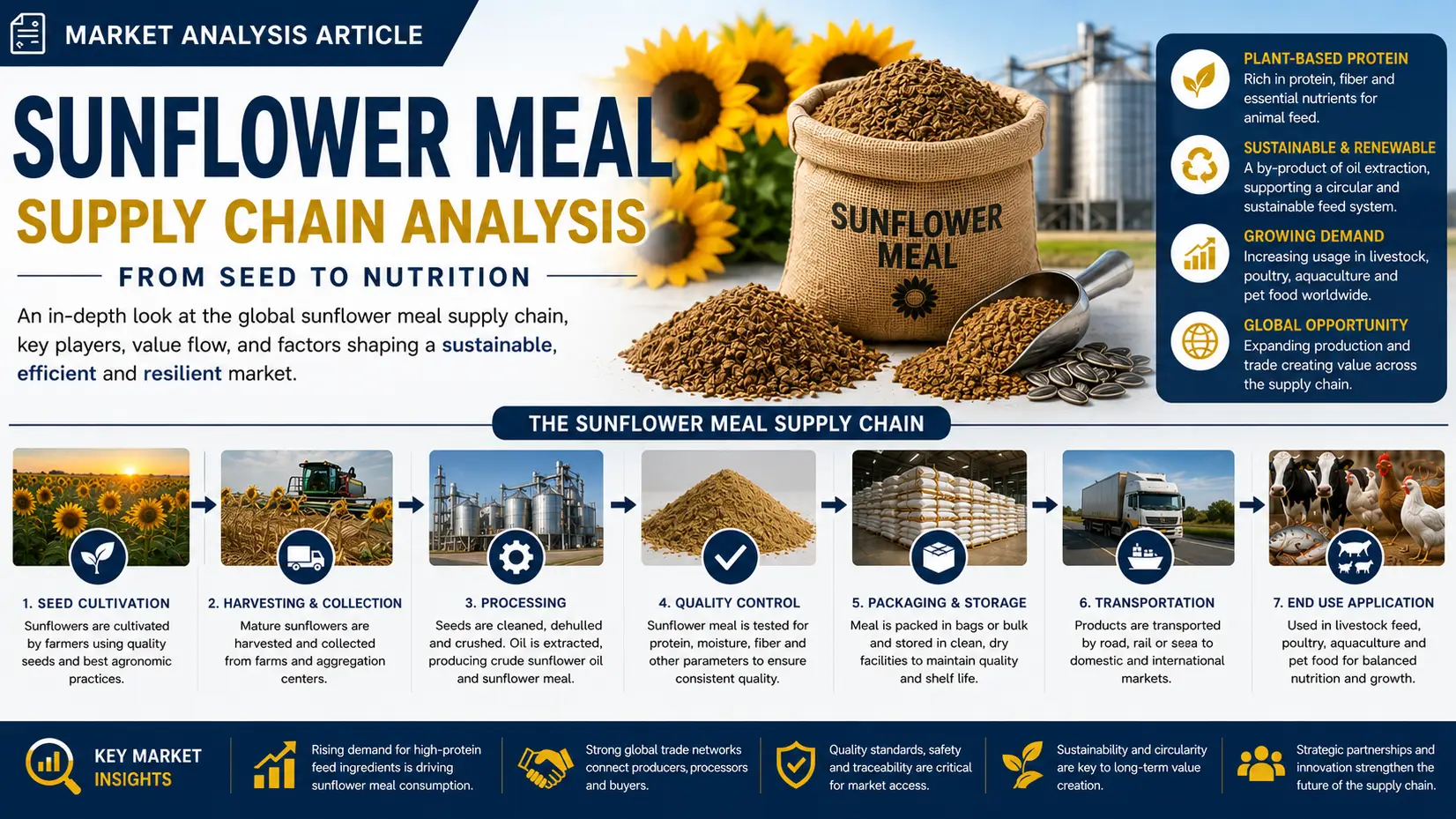
The sunflower meal supply chain begins with sunflower cultivation and continues through seed collection, oil extraction, meal processing, storage, transportation, and export distribution.
Each stage of the supply chain influences product quality, pricing, and delivery performance, making supply chain visibility an important factor for procurement teams.
According to information from agricultural commodity associations and trade reports, most sunflower meal enters international markets through exporters, commodity traders, distributors, and feed ingredient suppliers.
Processing facilities determine product specifications through extraction methods, dehulling practices, and quality management procedures. These variables influence nutritional profiles and commercial value.
Global logistics networks play a critical role because sunflower meal is frequently transported in bulk quantities across international markets. Freight costs and port efficiency can significantly impact landed costs.
As supply chains become increasingly interconnected, buyers often seek partners capable of providing documentation, traceability, and reliable logistics support throughout the procurement process.
Sunflower meal buyers are primarily focused on securing consistent product quality, reliable supply, competitive pricing, and compliance with feed industry requirements.
Procurement teams increasingly conduct detailed supplier evaluations to minimize operational risk and ensure long-term sourcing stability.
Typical buyers include feed manufacturers, livestock producers, agricultural cooperatives, feed distributors, commodity traders, and integrated farming enterprises.
According to feed industry sourcing practices and procurement standards, buyers commonly assess protein content, fiber levels, moisture specifications, contamination controls, packaging options, and shipment reliability.
Supplier comparisons are important because nutritional consistency directly affects feed formulation performance and production economics. Buyers also evaluate supplier reputation, production capacity, export experience, and quality certifications.
A well-structured product page supports sourcing decisions by providing technical specifications, supply availability information, application guidance, and procurement contact channels that facilitate efficient purchasing processes.
Selecting the right supplier is a critical component of successful procurement. Quality inconsistencies, delivery delays, and documentation issues can create operational challenges for feed manufacturers and agricultural businesses.
Organizations often establish supplier qualification processes to improve transparency and reduce sourcing risks.
Technical guidance from agricultural trade organizations emphasizes the importance of supplier audits, product testing, specification verification, and supply continuity assessments.
Buyers should evaluate manufacturing capabilities, quality assurance procedures, export documentation practices, and logistics support when selecting suppliers.
Long-term sourcing relationships often provide advantages such as improved forecasting, stable supply agreements, and better responsiveness during market fluctuations.
For companies operating internationally, supplier networks with regional distribution capabilities may help improve procurement flexibility and inventory management.
The long-term outlook for sunflower meal remains closely connected to growth in animal protein production and increasing demand for efficient feed ingredients.
Industry participants are also exploring ways to improve nutritional value, processing efficiency, and sustainability throughout the supply chain.
Market studies from agricultural research organizations indicate that rising global demand for meat, dairy, and aquaculture products will continue supporting feed ingredient consumption over the coming years.
Sustainability initiatives are encouraging greater utilization of agricultural byproducts, positioning sunflower meal as an important component of circular economy strategies within agribusiness.
Advancements in feed formulation technologies may further expand sunflower meal utilization rates by optimizing nutritional performance in livestock diets.
As global feed markets evolve, manufacturers, distributors, and procurement professionals are likely to increase their focus on diversified protein sources, creating additional opportunities for sunflower meal suppliers.
Sunflower meal remains a strategically important feed ingredient within the global agricultural supply chain. Its role as a protein-rich byproduct of sunflower oil production makes it valuable for feed manufacturers seeking cost-effective and reliable nutritional solutions.
Growing livestock production, expanding feed demand, and evolving procurement requirements continue to support market opportunities for sunflower meal. For manufacturers, traders, distributors, and sourcing teams, understanding supply chain dynamics, buyer expectations, and market developments is essential for making informed purchasing decisions and building resilient supply partnerships.
We're committed to your privacy. Tradeasia uses the information you provide to us to contact you about our relevant content, products, and services. For more information, check out our privacy policy.


 English
 Indonesian
 简体字
简体字
 العربية
 Español
 Français
 Português
 日本語
日本語
 한국어
한국어
 Tiếng Việt