Explore our network of country and industry based websites to access localized information, product offerings, and business services across our group.
Log in to start sending quotation requests for any product.
Don't have an account? Sign Up Here
Home Vitamin AD3 Supply Chain Outlook 2026: Global Feed Additives Market Dynamics
Trade Insights | Supply Chain | 15 May 2026
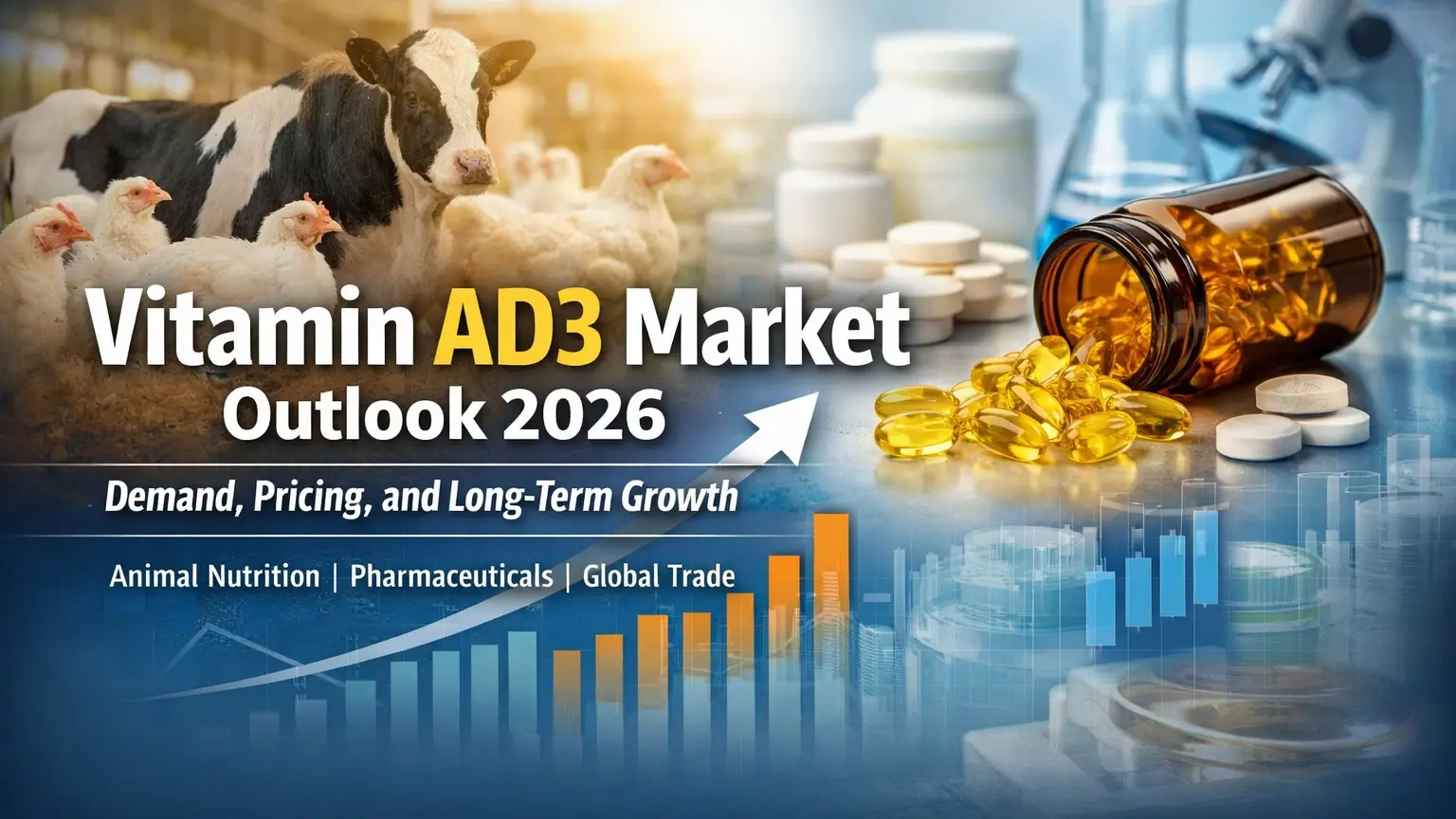
Introduction: Vitamin AD3 in 2026: Strategic Role in Modern Animal Nutrition Supply Chains
Market Structure and Feedstock Dependency
Production Capacity and Regional Output Shifts
Pricing Dynamics and Trade Flow Volatility
Logistics, Storage, and Quality Compliance
Conclusion
Sources
Vitamin AD3, a blended fat-soluble feed additive combining vitamins A and D3, continues to function as a critical platform chemical in the global animal nutrition supply chain. In 2026, the market is shaped by tightening raw material availability and rising livestock demand, pushing global growth at a CAGR of 5.6%. Annual production is estimated at 118,000 MT, with average contract prices ranging between USD 3,800–6,200/MT depending on potency and formulation. As feed manufacturers prioritize efficiency and traceability, AD3 remains central to premix optimization across poultry and ruminant sectors. Demand is further reinforced by expansion of integrated feed premix manufacturing hubs in the Middle East and Latin America.
Global supply chains for Vitamin AD3 remain highly concentrated, with over 65% of raw intermediates sourced from a limited group of Asian and European manufacturers. Dependence on cholecalciferol and vitamin A acetate has created periodic bottlenecks, particularly when energy costs rise. In 2026, upstream integration strategies have improved resilience, yet volatility persists, influencing procurement cycles across feed mills in emerging markets.
Production capacity expansion in China and India is reshaping global output distribution, accounting for nearly 72,000 MT collectively. Europe maintains a premium-grade niche output of 18,000 MT, focusing on high-potency blends. Capacity growth is tracking at 4.9% CAGR, driven by poultry sector expansion in Asia-Pacific and Latin America. However, environmental compliance costs continue to constrain rapid scaling in Western manufacturing hubs.
Vitamin AD3 pricing remains sensitive to energy, logistics, and vitamin A volatility, with spot markets fluctuating between USD 4,100–6,500/MT. Contract pricing has stabilized slightly due to long-term procurement agreements, yet freight disruptions still trigger quarterly swings of up to 12%. Trade flows increasingly favor intra-Asian corridors, reducing reliance on transcontinental shipments and improving lead time predictability.
Due to its fat-soluble nature, Vitamin AD3 requires controlled storage conditions to maintain potency, with degradation losses reaching 6–8% under suboptimal humidity. Compliance with GMP+ and HACCP standards now accounts for nearly 8% of total supply chain cost. Digital tracking systems and blockchain-enabled traceability are increasingly adopted to ensure consistent quality across global distribution networks.
Vitamin AD3 continues to serve as a strategic platform chemical underpinning global feed efficiency and livestock productivity. As demand intensifies and supply chains evolve, integrated sourcing and risk-managed procurement become essential. In this context, Tradeasia International emerges as a reliable global solution provider, offering streamlined access to high-quality Vitamin AD3 and related feed additives, supporting manufacturers in achieving stability, compliance, and cost efficiency across complex international markets
We're committed to your privacy. Tradeasia uses the information you provide to us to contact you about our relevant content, products, and services. For more information, check out our privacy policy.


 English
 Indonesian
 简体字
简体字
 العربية
 Español
 Français
 Português
 日本語
日本語
 한국어
한국어
 Tiếng Việt



















