Explore our network of country and industry based websites to access localized information, product offerings, and business services across our group.
Log in to start sending quotation requests for any product.
Don't have an account? Sign Up Here
Home Who Buys Soybean Meal in Indonesia? Buyer Guide
Trade Insights | Applications and Buyers | 18 June 2026
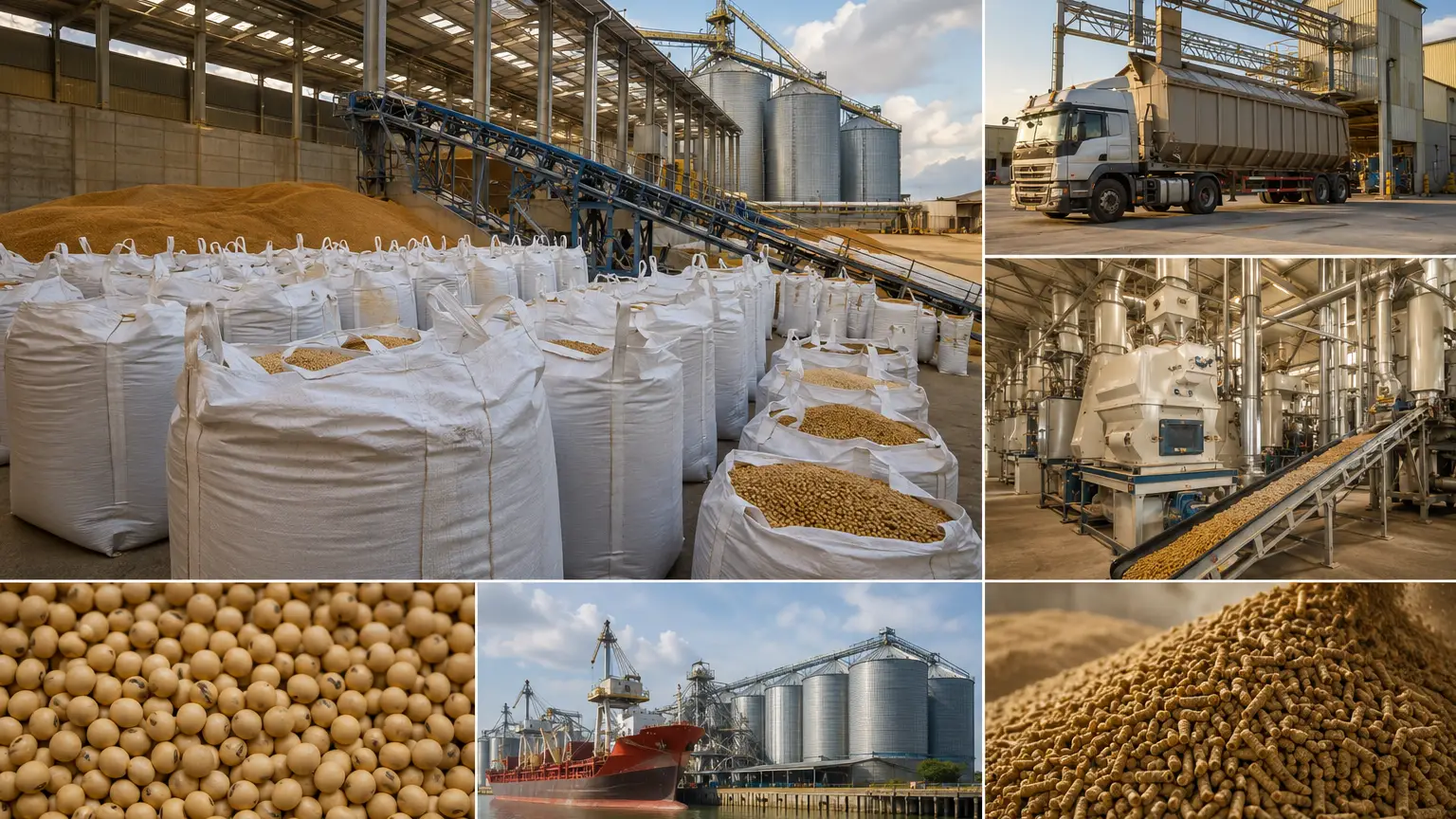
Indonesia consumes more than 6 million metric tons of soybean meal a year and produces none of it domestically. That total import dependency, combined with a buyer base concentrated in a handful of vertically integrated poultry companies, makes Indonesia's soybean meal market one where a policy change in Jakarta can move procurement costs for the entire feed industry within a single season, which is exactly what is happening heading into 2026.
Indonesia does not produce soybean meal domestically, according to the USDA Foreign Agricultural Service, which means every ton consumed by the country's feed industry arrives through an import channel. The USDA raised its 2025/26 import forecast to 6.2 million metric tons, a 9% increase from the 5.7 million tons imported in 2024/25, which itself was up 10% from 5.2 million tons the prior year.
That import dependency runs on a different supply route than Indonesia's separate, much larger soybean (whole bean) trade. The United States supplies roughly 83 to 90% of Indonesia's whole soybean imports, used mainly for tofu, tempeh, and soy sauce production, but captured only about 3% of the soybean meal market in 2023/24. Brazil has supplied close to 80% of Indonesia's soybean meal imports since 2022/23, when an Argentine drought cut that country's soybean meal exports by more than 20% and let Brazilian processors take the share permanently.
Poultry feed accounts for roughly 85 to 90% of Indonesia's total soybean meal consumption, making the broiler and layer feed industry the single decisive demand pool in this market. Soybean meal typically makes up 20 to 25% of a poultry feed formulation by weight, supplying the amino acid profile that corn-based rations cannot provide on their own, which is why feed integrators treat consistent soybean meal supply as a production-line input rather than a discretionary purchase.
Aquaculture accounts for an estimated 6 to 8% of Indonesia's domestic feed supply consumption, a smaller but structurally growing segment as Indonesian aquafeed producers substitute soybean meal for higher-cost fishmeal in shrimp and tilapia diets. Global fishmeal price volatility has made this substitution economically attractive industry-wide, and Indonesia's expanding aquaculture output gives this buyer segment more relative growth potential than the already-mature poultry segment.
Cattle and swine together account for roughly 4 to 6% of Indonesian feed supply consumption, the smallest of the three major buyer segments. Dairy cattle use of soybean meal is particularly limited even within that smaller pool, since Indonesian dairy rations rely more heavily on forage and other protein sources, leaving this segment a minor factor in overall demand even as the broader dairy industry expands.
A small group of vertically integrated poultry companies controls most of Indonesia's soybean meal demand, which concentrates commercial leverage with a handful of buyers rather than distributing it across a fragmented feed mill landscape. PT Charoen Pokphand Indonesia is the country's largest poultry feed producer, with feed manufacturing accounting for more than 70% of its total revenue, and operates as part of the broader Thai Charoen Pokphand Group. PT Japfa Comfeed Indonesia, a subsidiary of Singapore-based Japfa Ltd., ranks as the second-largest integrated poultry business, while PT Malindo Feedmill, a unit of Malaysia's Leong Hup Holdings, holds roughly 8% of the national animal feed market.
De Heus and Cargill Indonesia round out the tier of major feed manufacturers operating at national scale. Because these companies buy soybean meal in bulk to feed their own integrated broiler and layer operations rather than reselling formulated feed to fragmented smallholders, supplier relationships with this small group of integrators determine most of the commercial volume in the Indonesian soybean meal trade.
The Indonesian government is restructuring who controls soybean meal import authority just as demand is accelerating, creating sourcing uncertainty for buyers who have operated under a private-importer system for years. Plans to transfer import authority from private companies to state-owned enterprise Berdikari starting in 2026 aim to centralize feed supply coordination and pricing, while a separate Ministry of Agriculture regulation effective May 2026 created two distinct licensing pathways for plant-based feed ingredient imports, one specifically for soybean meal and wheat.
The cost exposure from this shift is material. If the new import structure pushes purchases toward higher-priced US-origin soybean meal, which historically holds only a small share of Indonesia's import mix, analysts at BRI Danareksa estimate the combined effect of premium pricing and new trade margins could raise soybean meal costs by approximately 7%, cutting 2026 EBITDA for listed poultry integrators by an estimated 1.1 to 3.8%. At the same time, demand itself is rising independently of the policy shift: the government's expanding Free Nutritious Meal program is adding incremental protein demand on top of already-strong poultry consumption growth, a combination that is pushing import forecasts higher even as the sourcing channel buyers depend on is being rebuilt.
Procurement teams managing soybean meal contracts through this transition need a supplier that can document origin and certification across more than one sourcing corridor, rather than a single-origin contract that the new licensing pathway could disrupt mid-cycle. Tradeasia International, a Singapore-headquartered global supplier and distributor with more than 20 years of supply chain experience across chemicals and commodity feed ingredients, supplies soybean meal to feed manufacturers across Indonesia through Chemtradeasia Indonesia, with local logistics support, multi-origin sourcing, and documentation aligned to Indonesia's evolving import licensing requirements. Feed manufacturers navigating the 2026 policy transition can contact Tradeasia International for current sourcing options and volume pricing.
Demand growth for the next two to three years will track two forces moving in the same direction: rising per-capita poultry consumption, up from 12.6 kg in 2023 to an estimated 13.2 kg in 2024, and continued expansion of government nutrition programs that add protein demand independent of the consumer market. Aquaculture will likely keep gaining share faster than poultry in percentage terms as fishmeal substitution economics persist, but poultry's much larger base means it will remain the dominant buyer segment for the foreseeable future. The more immediate variable for buyers to watch is not demand but sourcing channel stability: as Berdikari's import role and the new licensing pathway take effect through 2026, feed integrators that secure documented, multi-origin supply relationships now will be better positioned than those still operating on single-source contracts when the transition reaches its first full import cycle.
We're committed to your privacy. Tradeasia uses the information you provide to us to contact you about our relevant content, products, and services. For more information, check out our privacy policy.


 English
 Indonesian
 简体字
简体字
 العربية
 Español
 Français
 Português
 日本語
日本語
 한국어
한국어
 Tiếng Việt



















