Explore our network of country and industry based websites to access localized information, product offerings, and business services across our group.
Log in to start sending quotation requests for any product.
Don't have an account? Sign Up Here
Home L-Arginine: Supply Chain Trends, Buyer Demand, and Global Opportunities
Trade Insights | Supply Chain | 08 June 2026

What Is L-Arginine and Why Is It Important?
Industrial Applications Driving Global Demand
Global Market Trends and Industry Outlook
Supply Chain Dynamics and Procurement Considerations
Buyer Intent and Purchasing Evaluation Criteria
Future Opportunities for Suppliers and Distributors
Conclusion
Sources
L-Arginine is a semi-essential amino acid widely used in nutrition, pharmaceutical, and industrial formulations. It plays a critical role in protein synthesis and nitric oxide production, making it valuable for both human and animal health applications.
According to the U.S. National Institutes of Health (NIH), L-Arginine is involved in multiple metabolic pathways related to cardiovascular function, immune response, and cellular growth. These characteristics have contributed to its growing use in commercial formulations.
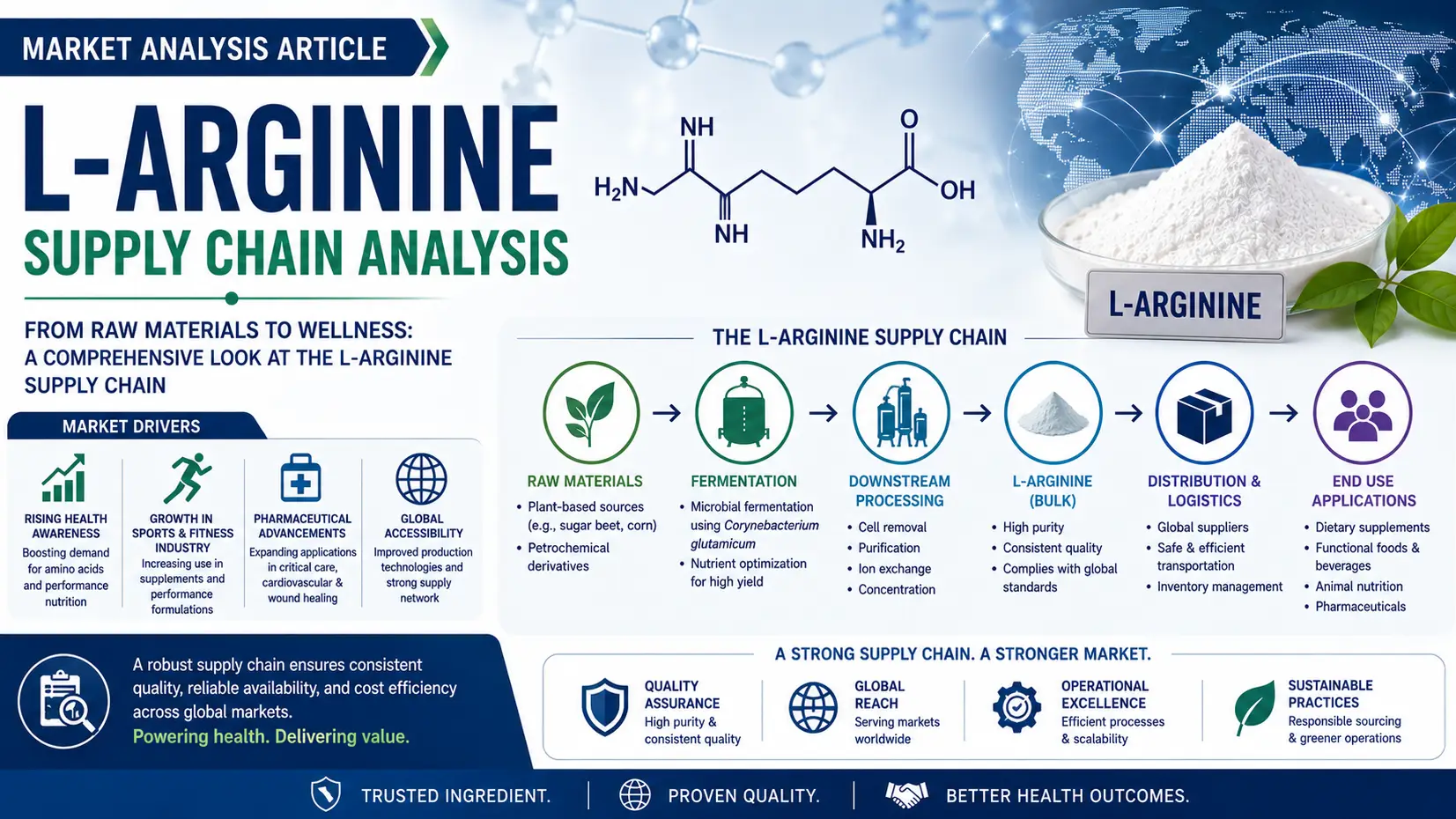
Manufacturers typically produce L-Arginine through fermentation processes utilizing microbial technology. Advances in biotechnology have improved production efficiency and product purity, supporting broader industrial adoption.
The ingredient is commonly available in food-grade, feed-grade, and pharmaceutical-grade specifications, allowing suppliers to serve diverse customer segments across international markets.
As demand for amino acid-based ingredients continues to expand, L-Arginine remains one of the most commercially significant specialty amino acids traded globally.
The versatility of L-Arginine has enabled its use across several high-growth industries. Its functional properties support applications ranging from nutritional supplements to pharmaceutical formulations and animal nutrition products.
Technical information published by the European Food Safety Authority (EFSA) highlights the importance of amino acids in nutrition and physiological functions. L-Arginine is widely incorporated into sports nutrition products designed to support performance and recovery.
In the pharmaceutical sector, manufacturers utilize L-Arginine in formulations targeting cardiovascular health, metabolic support, and specialized medical nutrition. Growing healthcare awareness has contributed to increased demand in these segments.
Animal feed producers also incorporate L-Arginine into feed formulations to support growth performance and nutritional optimization. The expansion of intensive livestock production continues to support consumption growth.
Food and beverage manufacturers increasingly explore amino acid fortification strategies as consumers seek functional ingredients that align with health and wellness trends.
The global L-Arginine market continues to benefit from rising health awareness, growing supplement consumption, and increased investments in biotechnology production capacity.
Market analysis published by industry research organizations consistently identifies amino acids as a growing segment within the nutrition and specialty ingredients industry. Demand growth is particularly evident in Asia-Pacific, North America, and Europe.
The sports nutrition market remains a major demand driver. Increasing participation in fitness activities and preventive healthcare programs has encouraged greater consumption of amino acid-based supplements.
Pharmaceutical manufacturers are also expanding their use of amino acid ingredients in therapeutic and clinical nutrition products. This trend supports long-term demand stability for L-Arginine suppliers.
In addition, advancements in fermentation technology continue to improve production economics, allowing manufacturers to expand supply while maintaining product quality standards required by international buyers.
Understanding the L-Arginine supply chain is essential for procurement teams seeking reliable sourcing solutions. Market participants evaluate factors such as manufacturing capacity, regulatory compliance, logistics efficiency, and supplier reliability.
According to information published by the Food and Agriculture Organization (FAO), amino acid production increasingly relies on advanced fermentation technologies and efficient raw material sourcing. Production costs are often influenced by feedstock availability and energy expenses.
Many global suppliers are concentrated in Asia, where large-scale fermentation infrastructure supports competitive manufacturing costs. These production hubs play a significant role in global exports.
Procurement teams frequently assess product specifications, certificates of analysis, traceability documentation, and quality management systems before selecting suppliers. Consistent quality remains a key purchasing criterion.
Supply chain resilience has become increasingly important following recent global logistics disruptions. Buyers often diversify sourcing strategies to reduce procurement risks and ensure uninterrupted supply.
B2B buyers approach L-Arginine procurement with specific performance, quality, and commercial requirements. Understanding buyer intent can help suppliers align their offerings with market expectations.
Typical buyers include dietary supplement manufacturers, pharmaceutical companies, animal nutrition producers, food ingredient distributors, and contract manufacturers. These organizations require dependable supply and regulatory compliance.
Procurement professionals commonly evaluate purity levels, manufacturing standards, available certifications, lead times, packaging options, and production capacity when comparing suppliers.
Supplier comparisons are often driven by the need to balance quality assurance with competitive pricing. Buyers also assess technical support capabilities and documentation transparency.
Product pages on B2B chemical marketplaces support sourcing decisions by providing specifications, application information, supply availability, and supplier credentials that simplify supplier evaluation processes.
As global demand for functional ingredients continues to increase, L-Arginine presents attractive opportunities for manufacturers, traders, distributors, and procurement specialists.
According to reports from the World Health Organization (WHO) and nutrition industry publications, consumer interest in preventive health solutions continues to rise. This trend supports ongoing growth in amino acid consumption.
Emerging markets are expected to contribute significantly to future demand as healthcare access, nutritional awareness, and supplement adoption expand. Suppliers positioned in these regions may benefit from increasing procurement activity.
Innovation in personalized nutrition and specialized health products may create additional application opportunities for L-Arginine. Product developers increasingly seek scientifically supported functional ingredients.
For distributors and chemical trading companies, establishing reliable sourcing partnerships and maintaining diversified supplier networks can create long-term competitive advantages in the global amino acid marketplace.
L-Arginine has established itself as a strategically important amino acid across dietary supplements, pharmaceuticals, animal nutrition, and functional food applications. Growing health awareness, technological advancements in fermentation, and expanding end-use industries continue to support global demand.
For B2B buyers, successful procurement depends on evaluating supplier reliability, product quality, regulatory compliance, and supply chain resilience. As market opportunities expand, manufacturers, distributors, and procurement teams that develop strong sourcing strategies will be best positioned to capitalize on the growing global L-Arginine market.
We're committed to your privacy. Tradeasia uses the information you provide to us to contact you about our relevant content, products, and services. For more information, check out our privacy policy.


 English
 Indonesian
 简体字
简体字
 العربية
 Español
 Français
 Português
 日本語
日本語
 한국어
한국어
 Tiếng Việt