Explore our network of country and industry based websites to access localized information, product offerings, and business services across our group.
Log in to start sending quotation requests for any product.
Don't have an account? Sign Up Here
Home Manganese Carbonate: Procurement Insights for Industrial Buyers
Trade Insights | Supply Chain | 16 June 2026

What Is Manganese Carbonate?
Industrial Applications of Manganese Carbonate
Global Market Trends and Demand Drivers
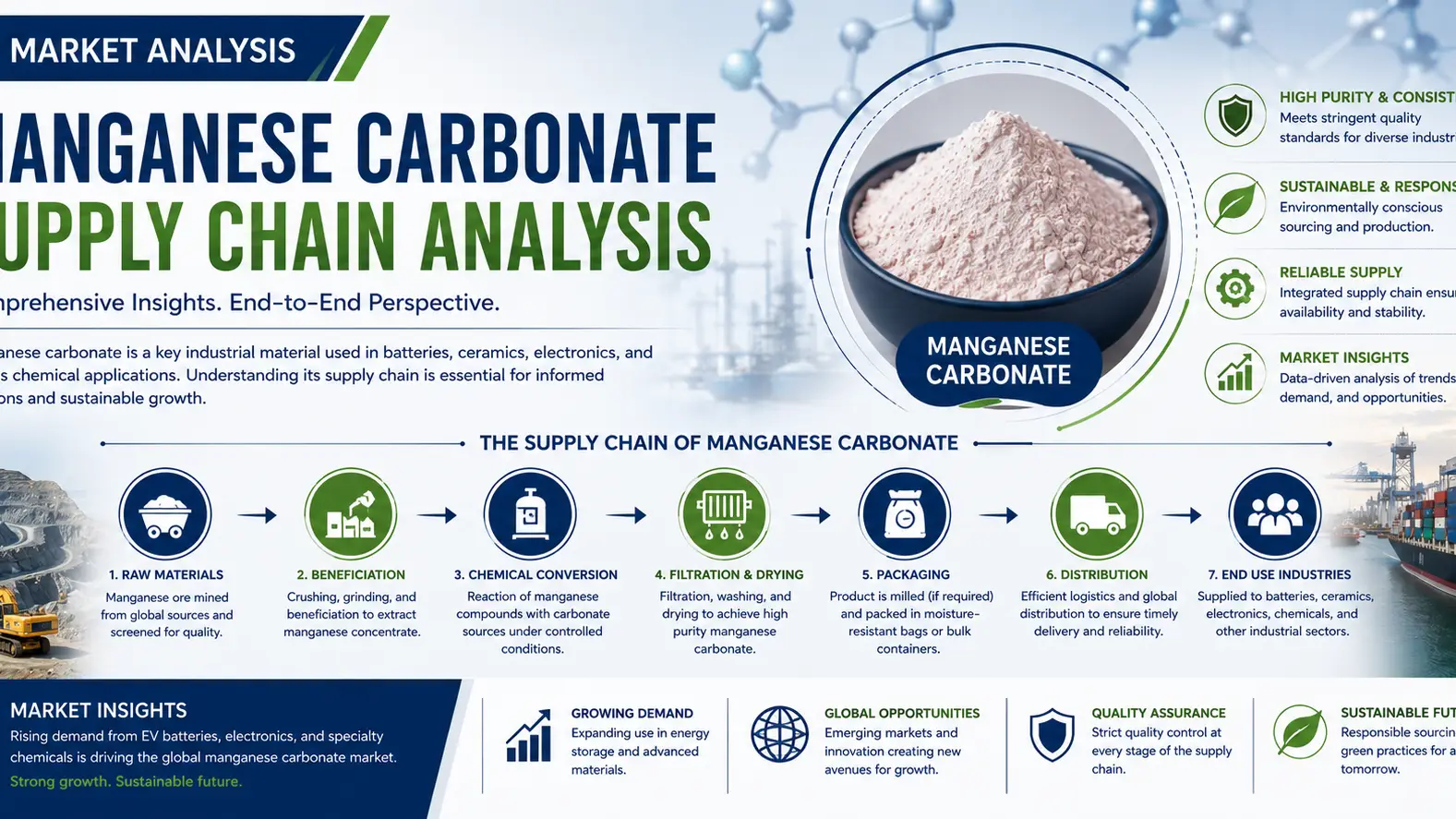
Supply Chain and Sourcing Considerations
Buyer Intent and Procurement Requirements
Future Outlook for Manganese Carbonate Markets
Conclusion
Sources
Manganese carbonate is an inorganic chemical compound with the formula MnCO3. It appears as a light pink to brown powder and serves as an important intermediate material in several industrial processes, particularly in the production of manganese-based compounds and specialty chemicals.
The compound is valued for its relatively high manganese content and its ability to decompose into manganese oxide when heated. These characteristics make it a suitable raw material for numerous industrial applications, including fertilizers, feed additives, pigments, and battery materials.
According to technical information published by the National Center for Biotechnology Information, manganese compounds play an essential role in biological and industrial processes due to their chemical versatility and trace mineral properties.
As industries continue to seek reliable sources of manganese-based materials, manganese carbonate remains an important product in the global specialty chemicals market because of its broad application range and relatively stable commercial demand.
Manganese carbonate serves several industries that require manganese as either a nutritional ingredient or a functional component in manufacturing processes. Its versatility contributes significantly to its international trade demand.
In the animal nutrition industry, manganese carbonate is widely used as a trace mineral supplement in livestock and poultry feed formulations. It helps manufacturers produce feed products designed to support animal growth and metabolic functions.
The agricultural sector also uses manganese carbonate in micronutrient fertilizers, particularly in regions where soil manganese deficiencies affect crop productivity. According to the Food and Agriculture Organization of the United Nations (FAO), micronutrient management continues to be an important factor in improving agricultural yields worldwide.
The compound additionally serves as a precursor in the manufacture of ceramics, pigments, and specialty manganese chemicals. Increasing interest in manganese-containing battery materials has also created new opportunities for downstream manufacturers seeking reliable manganese intermediates.
The global manganese market has experienced increasing diversification as traditional applications expand alongside emerging technologies. Demand for manganese compounds is being supported by both agricultural and industrial sectors.
The expansion of global food production continues to support demand for micronutrient fertilizers and feed additives containing manganese. Industrial growth in developing economies has also increased consumption of manganese compounds used in ceramics and specialty chemicals.
Market analysis published by the International Manganese Institute (IMnI) indicates that manganese demand is increasingly influenced by technological applications, including advanced battery chemistries and energy storage solutions.
The development of electric vehicle supply chains has also brought greater attention to manganese-based materials. Although manganese carbonate is not the final battery material itself, it can serve as an upstream raw material for producing higher-value manganese compounds used in battery manufacturing.
Procurement teams sourcing manganese carbonate often evaluate suppliers based on product quality, consistency, logistics capabilities, and regulatory compliance. Global sourcing requires balancing cost efficiency with supply reliability.
Buyers generally seek suppliers capable of providing stable specifications, appropriate packaging options, and documentation supporting quality standards. Supply chain resilience has become increasingly important following disruptions in global logistics and raw material markets.
According to market observations from the United States Geological Survey (USGS), manganese production and trade remain concentrated in several major producing regions, making supplier diversification an important procurement strategy.
Chemical distributors and manufacturers also assess transportation infrastructure, lead times, and long-term supply agreements when selecting sourcing partners for manganese carbonate and other industrial minerals.
The purchasing behavior surrounding manganese carbonate is largely driven by industrial requirements and technical specifications. Different industries often require varying purity levels and product grades.
Typical buyers include fertilizer manufacturers, feed additive producers, ceramic manufacturers, specialty chemical companies, and distributors serving regional industrial markets. Procurement teams commonly compare suppliers based on product consistency, certifications, and commercial flexibility.
Buyers also evaluate factors such as production capacity, supply security, and technical support. In highly competitive markets, sourcing decisions increasingly depend on the ability of suppliers to provide transparent information and responsive customer service.
A well-structured product page on a B2B chemical marketplace supports procurement decisions by presenting technical information, application guidance, and supplier communication channels that simplify the sourcing process for industrial customers.
The future outlook for manganese carbonate appears positive as several downstream industries continue to expand. Demand from agriculture and animal nutrition remains relatively stable, while advanced materials applications create new growth opportunities.
The transition toward electrification and renewable energy technologies has increased interest in manganese-based compounds. This trend may encourage further investment in manganese supply chains and processing technologies.
Industry reports from the International Energy Agency (IEA) highlight growing requirements for critical minerals used in clean energy technologies, including manganese and related materials.
As global industries prioritize supply security and diversification, procurement teams are expected to continue seeking dependable suppliers capable of meeting quality requirements and ensuring long-term availability of manganese carbonate products.
Manganese carbonate remains an important industrial chemical with applications spanning animal nutrition, agriculture, ceramics, specialty chemicals, and emerging battery materials. Its broad utility and expanding market opportunities make it a strategically relevant product for manufacturers and distributors.
The evolving global supply chain landscape has increased the importance of sourcing transparency, supplier reliability, and market intelligence. Businesses that understand application trends and procurement requirements are better positioned to secure stable supplies and capitalize on growing demand across multiple industries.
We're committed to your privacy. Tradeasia uses the information you provide to us to contact you about our relevant content, products, and services. For more information, check out our privacy policy.


 English
 Indonesian
 简体字
简体字
 العربية
 Español
 Français
 Português
 日本語
日本語
 한국어
한국어
 Tiếng Việt