Explore our network of country and industry based websites to access localized information, product offerings, and business services across our group.
Log in to start sending quotation requests for any product.
Don't have an account? Sign Up Here
Home Soybean Meal Supply Chain Outlook: Strategic Sourcing for Global Feed Markets
Trade Insights | Supply Chain | 03 June 2026
Understanding Soybean Meal and Its Market Importance
Key Industrial Applications Driving Soybean Meal Demand
Global Soybean Meal Supply Chain Landscape
Market Trends Influencing Soybean Meal Procurement
Buyer Intent and Procurement Considerations
Sourcing Opportunities Through B2B Marketplaces
Conclusion
Soures
Soybean meal is one of the most widely traded agricultural feed ingredients in the world. Produced as a byproduct of soybean oil extraction, it contains a high concentration of protein that makes it a valuable nutritional component for livestock and aquaculture feed formulations.
The global feed industry depends heavily on soybean meal because of its favorable amino acid profile, consistent availability, and established supply chains. According to the Food and Agriculture Organization (FAO), protein-rich feed ingredients remain critical to improving animal productivity and food security worldwide.
As livestock production continues to expand in emerging and developed economies, soybean meal has become a strategic commodity for feed manufacturers. Poultry, swine, dairy, beef, and aquaculture sectors rely on soybean meal to meet nutritional requirements efficiently.
Market information published by the United States Department of Agriculture (USDA) highlights soybean meal as one of the most important protein sources used in commercial animal feed formulations, supporting stable demand across international markets.
The primary application of soybean meal is in the animal nutrition sector, where it serves as a high-protein feed ingredient. Its nutritional characteristics help support growth performance, feed efficiency, and overall animal health across multiple species.
Demand growth for animal protein consumption continues to influence feed ingredient purchasing decisions. According to the Organisation for Economic Co-operation and Development (OECD) and FAO agricultural outlook reports, livestock production growth remains a major driver of protein feed demand.
Poultry producers represent one of the largest consumer groups for soybean meal due to the industry's need for protein-rich feed formulations. Swine and dairy sectors similarly depend on soybean meal as a core ingredient in balanced nutrition programs.
Aquaculture is also becoming an increasingly important end-use market. Technical research published by industry organizations such as the United Soybean Board indicates growing adoption of soybean-based proteins as sustainable feed ingredients in fish and shrimp production systems.
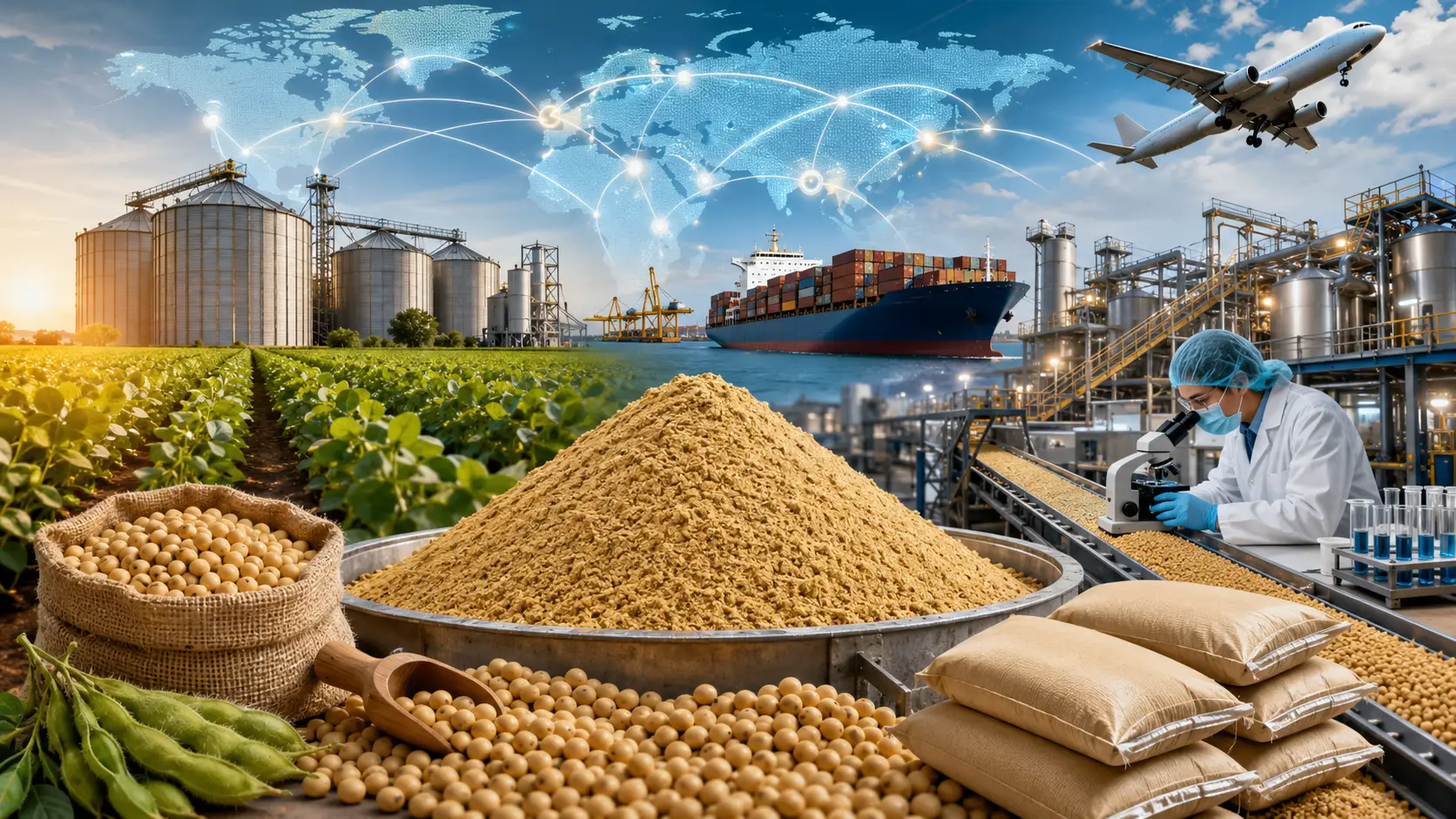
The soybean meal supply chain begins with soybean cultivation, followed by processing, crushing, oil extraction, storage, transportation, and distribution. Major producing countries include Brazil, the United States, and Argentina, which collectively account for a substantial portion of global soybean production.
International trade flows are heavily influenced by crop yields, weather conditions, transportation infrastructure, and geopolitical developments. According to USDA market reports, fluctuations in soybean harvests can significantly affect soybean meal availability and pricing worldwide.
South America has emerged as a dominant supplier of soybeans and soybean meal due to expanding agricultural production capacity and export-oriented infrastructure investments. Brazil in particular continues to strengthen its position in global agricultural exports.
On the demand side, Asia remains a major importing region driven by expanding livestock industries. Market analysis from the International Grains Council (IGC) shows that feed demand growth across Asia continues to support robust soybean meal trade volumes.
Procurement teams are increasingly focused on supply chain resilience, sustainability, and cost management when sourcing soybean meal. Volatility in commodity markets has encouraged buyers to diversify suppliers and strengthen sourcing networks.
According to market intelligence from the World Bank and agricultural commodity analysts, factors such as climate variability, logistics costs, and global trade policies continue to shape soybean meal market conditions.
Feed manufacturers are facing growing pressure from customers, regulators, and investors to improve supply chain transparency. Sustainability certifications and responsible sourcing initiatives are becoming more relevant in supplier evaluations.
Industry organizations such as the Round Table on Responsible Soy (RTRS) have promoted standards that help buyers verify responsible sourcing practices. These developments are influencing procurement strategies across global feed supply chains.
Soybean meal buyers typically include feed manufacturers, livestock integrators, aquaculture producers, agricultural distributors, and commodity trading companies. Their purchasing decisions are often influenced by product quality, protein content, supply reliability, and pricing competitiveness.
Procurement teams must evaluate supplier capabilities carefully to ensure continuity of supply and consistent product specifications. Industry guidance from feed associations and agricultural trade organizations emphasizes the importance of quality assurance and supplier performance.
Buyers often compare suppliers based on production capacity, logistics capabilities, quality certifications, origin options, and contractual flexibility. These considerations help reduce operational risks while supporting long-term procurement objectives.
A well-structured product page within a B2B marketplace supports sourcing decisions by providing technical information, supply availability insights, and supplier connectivity. This improves purchasing efficiency for procurement professionals seeking qualified supply partners.
Digital B2B marketplaces are transforming how agricultural commodities and feed ingredients are sourced globally. Buyers increasingly use online sourcing platforms to identify suppliers, compare offers, and streamline procurement processes.
Research from industry analysts and commodity trading publications indicates that digital procurement adoption continues to grow across agricultural supply chains due to efficiency improvements and expanded supplier visibility.
Platforms such as Tradeasia, Chemtradeasia, and Tradechem Marketplace help connect buyers with verified suppliers and trading partners across international markets. This improves market accessibility while supporting cross-border sourcing activities.
By consolidating product information, supplier networks, and procurement channels, B2B marketplaces enable organizations to respond more effectively to changing market conditions and sourcing requirements in the soybean meal industry.
Soybean meal remains one of the most important protein feed ingredients supporting global livestock and aquaculture production. Its widespread use, strong nutritional value, and established trade networks continue to drive significant international demand.
As supply chains evolve, procurement teams are increasingly focused on supplier reliability, sustainability, traceability, and market intelligence. Understanding these dynamics allows buyers, distributors, and manufacturers to make informed sourcing decisions.
The growing adoption of digital B2B marketplaces further enhances sourcing efficiency by connecting stakeholders across the soybean meal value chain. For organizations seeking long-term supply security and competitive procurement strategies, soybean meal will remain a critical commodity within the global feed industry.
We're committed to your privacy. Tradeasia uses the information you provide to us to contact you about our relevant content, products, and services. For more information, check out our privacy policy.


 English
 Indonesian
 简体字
简体字
 العربية
 Español
 Français
 Português
 日本語
日本語
 한국어
한국어
 Tiếng Việt



















