Explore our network of country and industry based websites to access localized information, product offerings, and business services across our group.
Log in to start sending quotation requests for any product.
Don't have an account? Sign Up Here
Home Global L-Valine Sourcing Guide for Feed, Pharma & Nutraceutical Buyers
Trade Insights | Applications and Buyers | 22 June 2026
Global Market Overview of L-Valine and Demand Drivers
L-Valine Applications in Animal Nutrition and Feed Industry
Pharmaceutical and Nutraceutical Uses of L-Valine
Fermentation-Based Production and Global Supply Chain
Key Buyers and Procurement Decision Factors
Buyer Intent and Strategic Sourcing Guidance
Sources
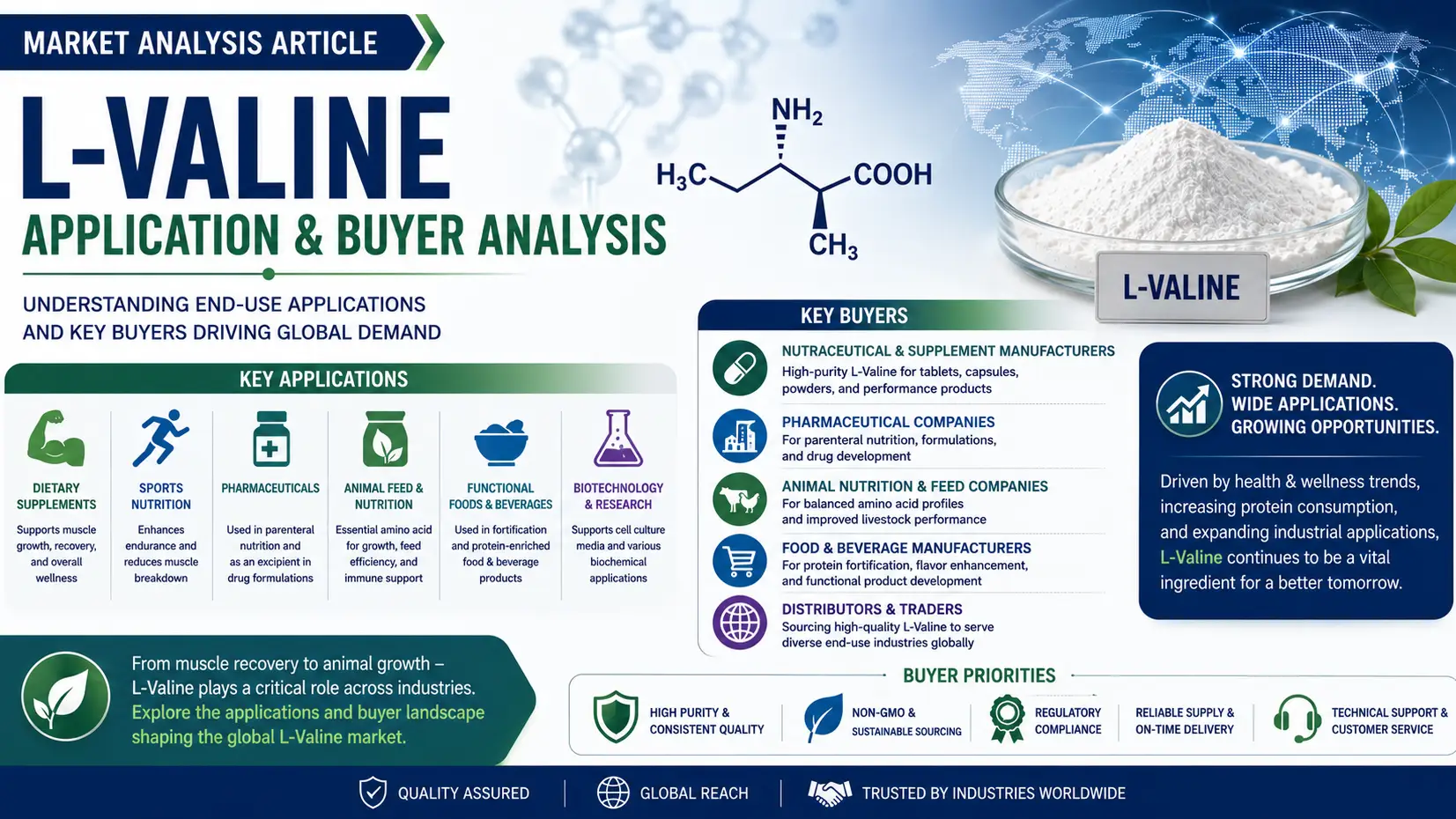
The global demand for L-Valine continues to expand as industries increasingly rely on essential amino acids to enhance productivity and nutritional efficiency. According to the Food and Agriculture Organization (FAO), amino acids are critical in optimizing protein utilization in both human and animal nutrition systems. This trend has positioned L-Valine as a key industrial input across multiple value chains.
L-Valine is classified as an essential branched-chain amino acid (BCAA), meaning it cannot be synthesized by animals or humans and must be supplied externally. This biochemical necessity drives consistent procurement demand, especially in large-scale feed formulation and pharmaceutical production.
Industrial buyers view L-Valine as a strategic additive rather than a commodity ingredient due to its direct impact on metabolic efficiency and growth performance. As a result, procurement volumes are increasingly tied to livestock production cycles and nutraceutical consumption growth.
The market is shaped by global protein consumption trends, with Asia-Pacific and North America leading demand expansion.
The rising focus on protein efficiency in livestock farming is a major driver for L-Valine consumption. Research published by the European Food Safety Authority (EFSA) highlights the importance of amino acid balancing in reducing feed costs and improving animal health outcomes.
L-Valine is often used in combination with lysine and methionine to optimize feed conversion ratios. This makes it a critical component in modern feed formulation strategies aimed at sustainable livestock production.
Market dynamics are also influenced by regulatory pressure to reduce crude protein levels in animal feed while maintaining performance. This shift increases dependence on crystalline amino acids like L-Valine.
Overall, demand is expected to remain stable and growing due to structural changes in global food production systems.
L-Valine plays a vital role in animal nutrition, particularly in swine and poultry feed formulations. According to the U.S. Department of Agriculture (USDA), amino acid supplementation is essential for optimizing feed efficiency and reducing nitrogen waste in livestock systems.
Feed manufacturers incorporate L-Valine to balance amino acid profiles in low-protein diets. This ensures animals receive sufficient nutrients without excessive raw protein input.
The use of L-Valine helps improve growth performance, muscle development, and feed conversion ratios. These benefits are particularly important in commercial farming operations where cost efficiency is a priority.
As livestock production intensifies globally, demand for feed-grade L-Valine continues to rise steadily.
Feed producers increasingly rely on L-Valine to support sustainable agriculture initiatives. Industry studies from the International Feed Industry Federation (IFIF) emphasize amino acid supplementation as a key strategy for reducing environmental impact.
By reducing reliance on high-protein feed ingredients, L-Valine helps lower nitrogen emissions and feed costs. This aligns with global sustainability targets in animal agriculture.
Large-scale feed mills integrate L-Valine into precision nutrition models that optimize dietary formulations. This improves both economic and environmental performance.
The shift toward sustainable livestock production ensures continued industrial demand for L-Valine.
L-Valine is widely used in pharmaceutical applications due to its role in protein synthesis and muscle metabolism. According to the World Health Organization (WHO), essential amino acids are critical for maintaining physiological balance in clinical nutrition systems.
It is commonly included in intravenous nutritional solutions and recovery formulations for patients with metabolic disorders or post-surgical needs.
Pharmaceutical manufacturers value L-Valine for its stability and compatibility in amino acid blends. It is often combined with leucine and isoleucine in therapeutic formulations.
Its medical relevance ensures consistent demand from pharmaceutical ingredient suppliers worldwide.
The nutraceutical industry represents a major growth area for L-Valine consumption. Market research published by Grand View Research indicates strong growth in amino acid-based sports supplements driven by fitness and wellness trends.
L-Valine is a key component in BCAA supplements used for muscle recovery and endurance enhancement. It is widely adopted in powder and capsule formulations targeting athletes and active consumers.
Nutraceutical manufacturers prioritize high-purity L-Valine to ensure product efficacy and regulatory compliance. This increases demand for pharmaceutical-grade supply chains.
The expansion of fitness culture globally continues to strengthen this segment.
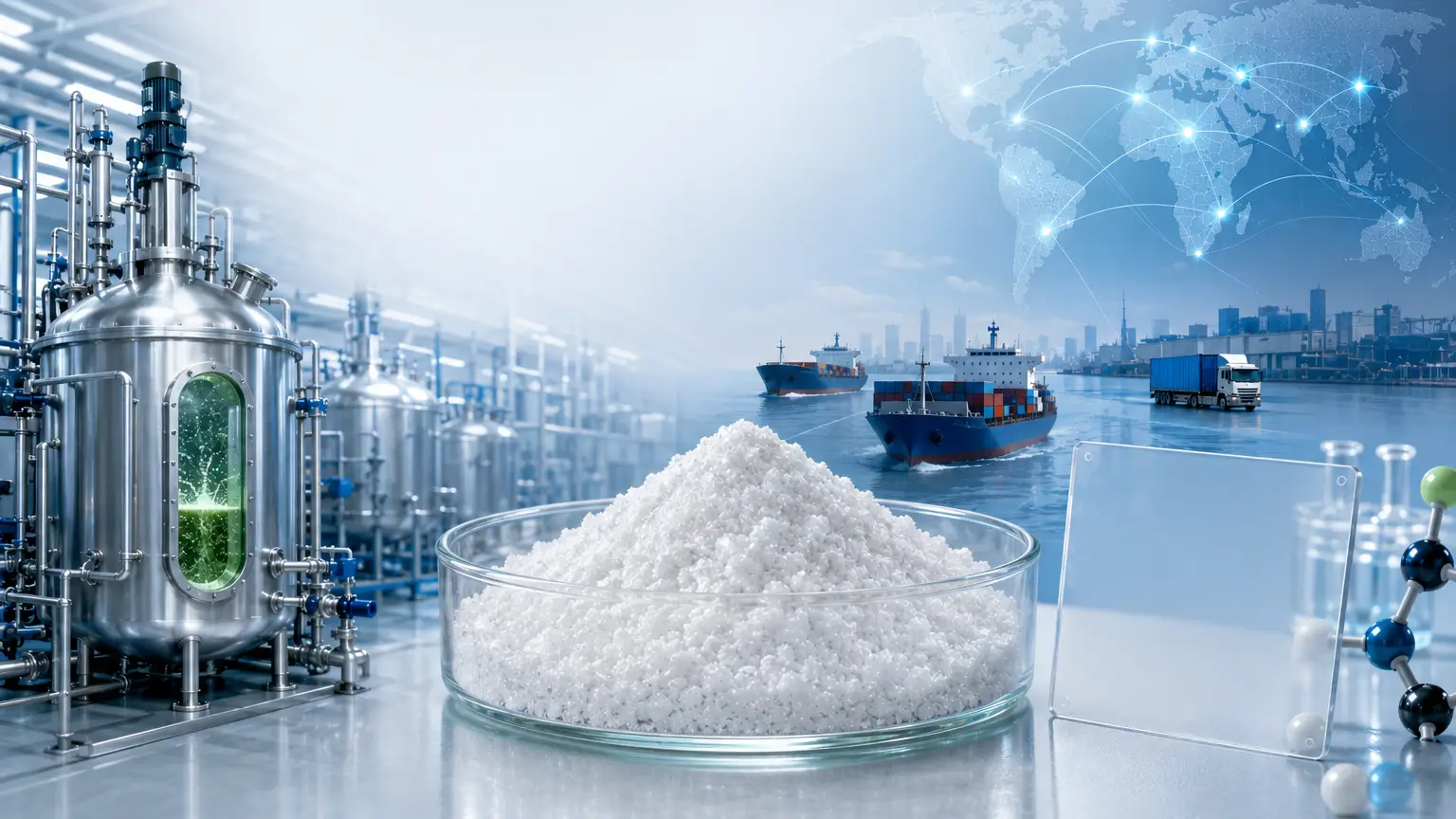
L-Valine is primarily produced through microbial fermentation using optimized bacterial strains. According to the Journal of Industrial Microbiology and Biotechnology, fermentation processes are the most efficient method for industrial amino acid production.
This method enables scalable production with high yield and consistent purity levels. It also reduces dependency on chemical synthesis routes.
Manufacturers invest heavily in biotechnological optimization to improve cost efficiency and production stability. This makes fermentation a critical factor in global supply competitiveness.
The production process directly influences pricing and availability in international markets.
The L-Valine supply chain is highly globalized, with major production hubs located in Asia and distribution networks extending to Europe and the Americas. Industry trade reports highlight the importance of integrated logistics in amino acid distribution.
Bulk shipping, warehouse optimization, and regulatory compliance play key roles in ensuring product availability. Buyers often rely on distributors with strong global sourcing networks.
Supply chain resilience has become increasingly important due to raw material volatility and energy costs.
This has led to stronger partnerships between manufacturers, traders, and chemical marketplaces.
Key buyers of L-Valine include animal feed manufacturers, pharmaceutical companies, nutraceutical producers, and chemical distributors. According to OECD agricultural outlook reports, amino acid demand is closely tied to livestock and health industry expansion.
Procurement teams evaluate L-Valine based on purity, grade specification, and regulatory compliance. Feed-grade and pharma-grade distinctions are particularly important in sourcing decisions.
Consistency of supply is a major factor due to its continuous use in production processes. Buyers typically prefer long-term contracts with reliable suppliers.
Industrial demand remains stable due to its essential biochemical role.
Buyers assess suppliers based on production capacity, quality assurance systems, and certification standards. Industry standards such as GMP and ISO certifications are often required for pharmaceutical-grade materials.
Pricing stability and logistics reliability also play a significant role in supplier selection. Procurement teams often compare multiple vendors before finalizing contracts.
Technical documentation and traceability are increasingly important in regulated industries. Buyers require full transparency on production methods and origin.
These factors shape competitive dynamics in the L-Valine supply market.
Buyer intent for L-Valine is primarily driven by operational necessity rather than discretionary demand. Feed mills and pharmaceutical companies require consistent amino acid input to maintain production continuity.
Procurement teams prioritize suppliers who can guarantee steady supply and technical consistency. This reduces operational risk in large-scale manufacturing environments.
Buyers also seek cost optimization through bulk purchasing and long-term agreements. This is particularly important in feed production where margins are tightly controlled.
As a result, L-Valine purchasing decisions are highly structured and data-driven.
B2B marketplaces play a critical role in connecting buyers with verified suppliers of L-Valine. These platforms simplify supplier comparison and improve procurement efficiency.
Buyers benefit from access to multiple sourcing options, enabling better price negotiation and quality benchmarking. This improves supply chain transparency.
Strategic sourcing also involves evaluating regional supply advantages, particularly in Asia-Pacific manufacturing hubs. This can reduce procurement costs and lead times.
Overall, effective sourcing strategies focus on reliability, scalability, and compliance assurance.
https://www.fao.org
https://www.efsa.europa.eu
https://www.grandviewresearch.com
We're committed to your privacy. Tradeasia uses the information you provide to us to contact you about our relevant content, products, and services. For more information, check out our privacy policy.


 English
 Indonesian
 简体字
简体字
 العربية
 Español
 Français
 Português
 日本語
日本語
 한국어
한국어
 Tiếng Việt